Yemen Monitor / Reports Unit / Exclusive:
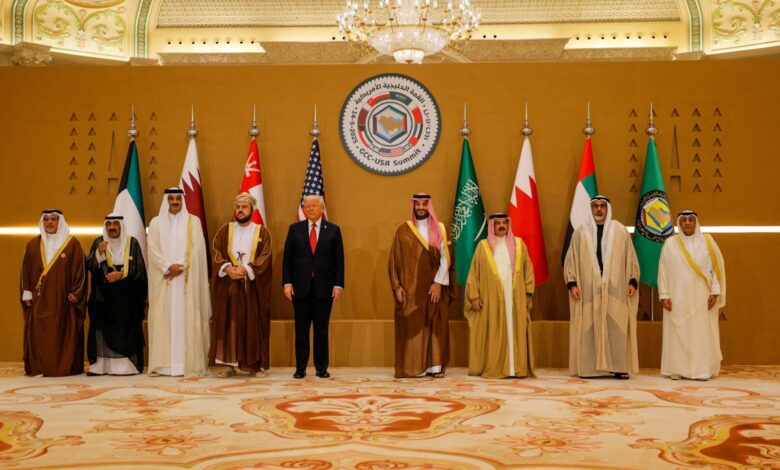
The U.S.-Gulf summit in Riyadh witnessed a notable event, as Saudi Crown Prince Mohammed bin Salman requested Kuwaiti Emir Sheikh Mishal Al-Ahmad Al-Sabah to amend a phrase in his speech regarding the Houthis.
The Kuwaiti Emir had referred to the Houthi group in Sana’a as the “relevant authorities” while praising the agreement reached between them and the US to halt hostilities against vessels in the red sea.
After his speech concluded, the Saudi Crown Prince clarified that the Kuwaiti Emir would revise the description “to avoid any misunderstanding.” Indeed, the Kuwaiti Emir later stated he meant to say “the illegitimate authorities,” thanking Bin Salman for pointing out the issue.
This is not the first time Kuwait has referred to the Houthis as “relevant authorities.” Oman used the same term during the announcement of the ceasefire agreement with the US last week. In a striking misstatement, the Sultan of Oman referred to the deal as one between the U.S. and Yemen—seemingly intentional.
This speech represents a precedent within the Gulf Cooperation Council (GCC) countries, where the Houthis still pose a vital threat to the security of the Arabian Peninsula and have caused the presence of international forces in nearby waters. This occurs at a time when the Gulf bloc is seeking to enhance regional security from countries within the region, particularly those bordering the Red Sea.
#ولي_العهد السعودي #محمد_بن_سلمان يراجع أمير #الكويت بشأن #الحوثيين pic.twitter.com/ACxsNixmu7
— يمن مونيتور (@YeMonitor) May 14, 2025
Cutting off the Houthis’ Line of Thinking
Therefore, the Saudi Crown Prince’s comment is of paramount importance in unifying the Gulf stance towards the dangers facing the Arabian Peninsula. Maintaining a policy of no unilateral reconciliation with the Houthis remains a crucial option for the bloc’s countries, preventing the Houthis from believing that achieving regional gains through threatening navigation is possible.
Last week, a Houthi official in Sana’a told “Yemen Monitor” that Muscat and Kuwait’s speeches were “encouraging; today they are a concerned authority, and tomorrow they will become a legitimate authority through independent agreements with Gulf states.”
It appears that the Americans are moving towards expanding the military agreement with the Houthis to include countries in the region. Michael Mitchell, the regional spokesperson for the US State Department, told a local Emirati newspaper: that the agreement is preliminary, and we want to expand it to stop any attacks by the Houthis against any of the concerned parties, not just against US interests, because ultimately, the Houthis pose a danger not only to US interests, but to the peoples of the entire region.
The Saudi Crown Prince’s comment cuts off the Houthis’ line of thinking regarding the possibility of achieving their goals by dragging the region into dangerous security burdens. It also halts the USs’ efforts to define the Houthis as a concerned authority with whom military agreements can be reached, bypassing the Yemeni people and the internationally recognized government.

Regional Threats… The Roadmap
At the beginning of the US-Gulf summit, at 10:00 AM on Wednesday, two significant events related to regional security occurred: First, the Israeli army once again announced a request to evacuate the three Houthi-controlled Yemeni ports (until further notice), a serious incident where the occupation continues to bomb infrastructure in the Arabian Peninsula, and Gulf countries receive these messages with anger. Second, a military statement was issued by the Houthis announcing the targeting of Israel’s Ben Gurion Airport, in a new escalation against the occupation, as they have launched three consecutive attacks since the US president began his tour in the region, starting in Riyadh.
Through this escalation, the Houthis aim to achieve two objectives: to threaten the region and demonstrate that anyone capable of striking Israel can strike others more swiftly and with greater force. They also seek to persuade the US and the Gulf states to strike a political deal with them that would establish the Houthis as the new legitimate authority—bypassing the internationally recognized government and without committing to any peace agreement with their rivals.
The Houthis believe that keeping the Gulf under the pressure of their missile threats—or dragging it into a regional war—represents a roadmap by which they can secure separate agreements recognizing them as the legitimate authority in Yemen, or at least in its northern part—especially with the UAE pursuing southern secession. This strategy seems aimed at replacing any dialogue with the Yemeni government to reach a just peace.
In his address to the UN Security Council on Wednesday, UN Special Envoy to Yemen Hans Grundberg pointed to a new tone in his discussion of the roadmap he has been pursuing for years. He acknowledged that positions are hardening over time and that the challenges are growing more complex.
He added: “Some may wonder whether the roadmap is still viable. My answer remains unchanged: Yemen still needs the elements of the roadmap—a ceasefire, economic recovery, and an inclusive political process to move forward.”
He continued: “But I am fully aware that the mediation environment has changed significantly since late 2023, and that there is a need for additional guarantees that will enable the parties to participate and ensure the support of the region, the international community, and this Council.”
Saudi Vigilance
Ultimately, the Saudi Crown Prince’s stance reflects the GCC countries’ adherence to their principles in maintaining regional security and supporting the internationally recognized legitimacy. This strong affirmation serves as a safety valve in the face of increasing challenges and underscores that the unity of the Gulf ranks is the protective shield of the Arabian Peninsula.
The vigilance of the Saudi leadership and its decisive handling of attempts to impose a fait accompli, as demonstrated in this position, sends a clear message about the future of Gulf engagement with regional crises. There remains hope that this unified approach will continue, ensuring the security and stability of the region and blocking any agendas that seek to destabilize it.