Leadership Failure and Ally Neglect… Yemen Missing from U.S.-Gulf Summit Agenda

Yemen Monitor / Exclusive:
The omission of the Yemen issue from the agenda of the U.S.-Gulf summit in Riyadh has sparked a wave of critical and sarcastic reactions in political and media circles, amid growing analysis pointing to an increasing marginalization of the decade-old Yemeni crisis, which remains unresolved.
Despite brief remarks by Saudi Crown Prince Mohammed bin Salman affirming the importance of a political solution, the absence of any concrete details or clear vision to resolve Yemen’s crisis has once again highlighted the problem of the Yemeni government’s “fragile legitimacy.” This comes as biting criticism continues to target Presidential Leadership Council Chairman Rashad al-Alimi and his team, accusing them of failing to leverage international and regional support to achieve either diplomatic or on-the-ground gains.
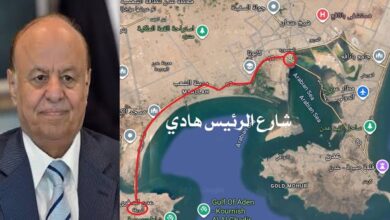
In a mocking gesture, activists circulated an old photo of former Yemeni President Abdrabbuh Mansur Hadi with former U.S. President Donald Trump during his first visit to Riyadh, questioning the complete absence of Rashad al-Alimi or any Yemeni official during Trump’s most recent trip to Saudi Arabia.
Commenting on this, Mohammed Abdulsalam, head of the “Abaad Studies Center”, noted the stark contrast between Syria’s prominent presence in international forums—despite its “incomplete legitimacy,” as he described it—and Yemen’s declining visibility, despite the international community’s recognition of its legal legitimacy.
He attributed this to the Yemeni leadership’s preoccupation with internal conflicts and corruption, saying: “The U.S. and Saudi Arabia cannot do everything on behalf of the Yemenis. Our Gulf brothers have given everything they could, but we must offer something ourselves if we want the world to respect us.”
This sentiment was echoed by activist Abdullah Ba-Azim, who described Yemen’s leadership as “a mix of war profiteers drowning in corruption,” contrasting them with Syria’s leadership, whom he said the Saudis view as “real statesmen” worthy of support.
In a similarly scathing tone, commentator Mohammed Al-Masqaei said, “I wish Al-Alimi had replaced al-Shara’ [a former Syrian official]… But our submissive leadership settled for its allowance and gave up its dignity.” Fayez Silan drew a direct comparison between Al-Alimi’s failure to gain domestic and international backing and the Syrian president’s success in strengthening his position despite immense challenges.
On the other hand, diplomat Abdulwahab Tawak attempted to shift the narrative, criticizing what he described as “misleading campaigns” targeting President Al-Alimi and questioning Saudi Arabia’s stance. He stressed that the Kingdom remains “a sincere ally” and that saving Yemen continues to be a priority in its foreign policy. However, his statements failed to quell ongoing questions about why no Yemeni official was seen during Trump’s recent visit, especially when compared to his previous trip where former President Hadi appeared prominently.
These conflicting comments reveal a deeper issue—the Yemeni elite’s failure to translate international legitimacy into a functioning state, resulting in Yemen becoming a peripheral issue in regional dynamics. It is now mostly referenced in discussions of Red Sea threats, while its political priority continues to decline as internal crises deepen.
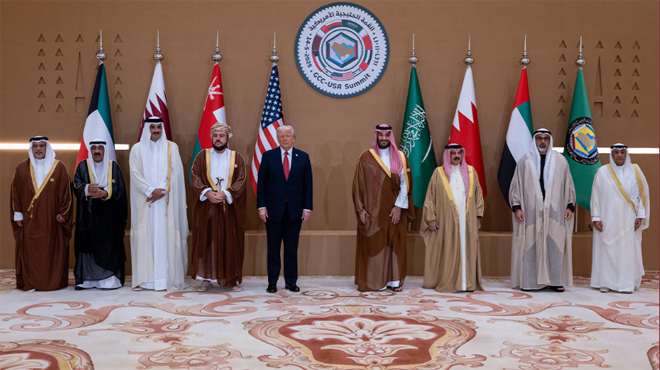
On Wednesday morning, the U.S.-Gulf summit was held in the Saudi capital, Riyadh, chaired by Saudi Crown Prince Mohammed bin Salman and U.S. President Donald Trump.
The Crown Prince announced shared positions on key regional files, including support for Syrian territorial unity, a call for a ceasefire in Sudan, encouragement of dialogue among Yemeni parties, and a reaffirmation of economic partnership with the US.
The summit concluded with a declaration to strengthen the strategic partnership between the Gulf and the U.S., continue coordination to resolve regional crises, support political efforts in Yemen, Syria, and Palestine, and boost joint economic and security cooperation.