Yemen Monitor / Newsroom:
The Chairman of the Yemeni Presidential Leadership Council, Rashad Al-Alimi, affirmed that the government will not allow any flights to arrive in the country outside the exclusive jurisdictions of the state, stressing that the Houthi group has no choice but to accept the proposed alternatives if it is keen on the interests of Yemenis. This came in a message considered the clearest since the recent escalation linked to the flight operations file.
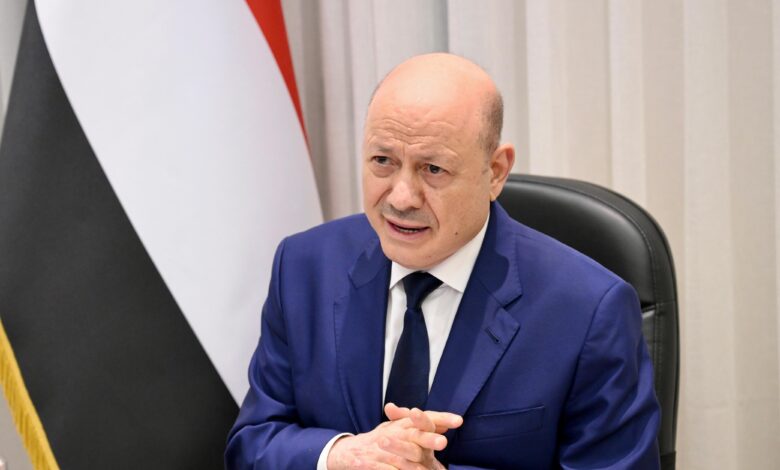
This took place during a meeting held by Al-Alimi on Saturday with Yemen’s ambassadors and heads of its diplomatic missions abroad, in the presence of the Prime Minister and Minister of Foreign Affairs and Expatriates, Shayea Al-Zindani. The meeting was dedicated to discussing the developments of the current stage and defining the priorities of diplomatic action in light of recent developments.
Al-Alimi said that the state “will not allow any flights to arrive outside its exclusive jurisdictions, and the Houthis have no choice but to accept these alternatives and prioritize the interests of the Yemeni people over their narrow interests,” stressing that the government welcomes all humanitarian initiatives aimed at alleviating the suffering of citizens, including the recent Jordanian initiative, provided that they take place within the framework of respecting the sovereignty of the state and its legitimate institutions.
He explained that over the past few days, the government has dealt with the Houthi escalation at the political, diplomatic, and military levels, with the aim of preventing any attempts to impose a fait accompli or agendas that do not serve the interests of Yemenis.
He added that the Yemeni authorities succeeded in shifting the issue from an attempt to portray it as merely operating a humanitarian flight to an issue concerning the sovereignty of a UN member state, representing a test of the international community’s commitment to respecting the rules of international law and implementing its resolutions.
Al-Alimi pointed out that the government has sensed an increasing understanding from a number of brotherly and friendly countries regarding its position, considering that this support must be capitalized on during the coming phase to enhance backing for the legitimate government and support efforts to restore security, stability, and peace in Yemen.
The Chairman of the Leadership Council called on Yemeni diplomatic missions to intensify their international movements in order to enhance the international isolation imposed on the Houthis and defend the legal status of the Yemeni state, while ensuring that the humanitarian interests of citizens are not harmed.
He stressed that the restoration of state institutions represents the only entry point to achieving a lasting peace, noting that the government will continue to remain open to humanitarian initiatives that contribute to alleviating suffering, but it will not accept any measures that bypass its sovereign powers.
In the same context, Al-Alimi emphasized that the role of diplomatic missions is no longer limited to the traditional representation of the state, but has become part of the battle to defend the Republic, its sovereignty, and its legitimate institutions, in light of what he described as the changing nature of conflicts.
He said that national battles are no longer settled on the battlefields alone, but also in international organizations, influential capitals, media outlets, and decision-making centers, stressing that the success of any political or military path has become dependent on the state’s ability to win international support and consolidate its national narrative against misinformation campaigns.
Al-Alimi directed the heads of missions to continue countering the narratives promoted by the Houthi group, relying on international law and facts to expose its violations, while highlighting what he described as its gross violations of human rights and its pursuit to undermine state institutions, principles of citizenship, and the rule of law.