Yemen Monitor/ Tehran/ Exclusive:
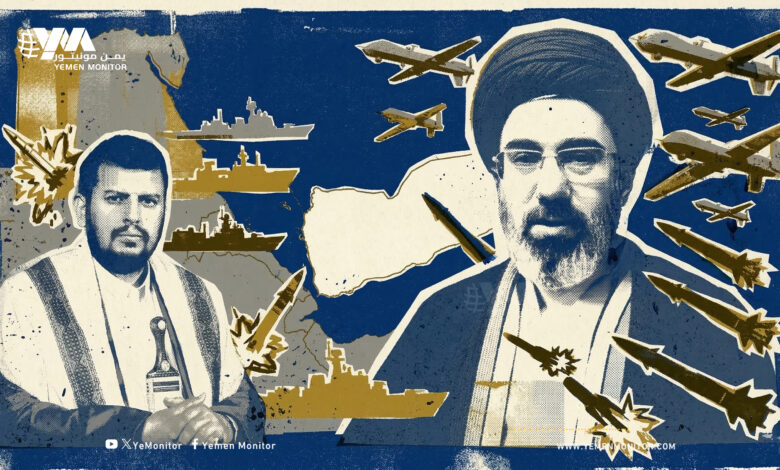
In an inaugural speech dominated by a military and strategic character, the new Iranian Supreme Leader, Mojtaba al-Husseini Khamenei, sent a strong message of thanks to the Houthi group in Yemen on Thursday, praising what he described as their “steadfastness” in the battle of Gaza.
The Leader revealed serious Iranian plans to expand the scope of confrontation by “opening new fronts” to face the front of “arrogance,” asserting that the “unity of arenas” will remain the fundamental pillar of Tehran’s foreign policy.
The new Supreme Leader of the Islamic Republic, Sayyid Mojtaba Khamenei, emphasized in his first official speech following the passing of his father that the cause of the “Resistance Front” represents an integral part of the values of the Islamic Revolution, stressing that Tehran will not back down from supporting its regional allies amidst the ongoing confrontation.
In his speech, Khamenei singled out his Houthi allies in Yemen with notable praise, describing their position as “brave and faithful,” and valuing the movement’s military engagement to defend the Palestinian people in Gaza despite all pressures.
The new Leader considered that the Houthis’ position, alongside the operations of Hezbollah and the Iraqi Resistance, formed a model of synergy that “will shorten the path to salvation from the Zionist strife,” as he put it.
In a strategic development reflecting Tehran’s intention to escalate the confrontation, Mojtaba Khamenei announced the conduct of “studies to open other fronts” against adversaries, explaining that these fronts would be in areas where “the enemy lacks sufficient experience and will be extremely fragile.”
He also stressed that the use of “closing the Strait of Hormuz” will remain in place as a deterrent and effective option, calling on the Iranian armed forces and their allies to continue operations that “leave the enemy with regret.”
Internally, Khamenei linked the success of his leadership to the extent of popular presence in the squares, calling on Iranians to “break the enemy’s thorn” through broad participation in upcoming political events. Regionally, he issued a stern warning to countries hosting American military bases, demanding their immediate closure and affirming that Tehran will continue to target those bases if they are used to attack Iranian territory.
The relationship between the United States and the Houthis has witnessed turmoil in recent years, as the U.S. military under Trump targeted the group with airstrikes in Yemen last year. Those attacks—which later became the heart of the “Signalgate” scandal—occurred after the Houthis shot down a U.S. military drone. Trump vowed at the time to “annihilate” the group completely, stopping only after an agreement between the Houthis and the Trump administration, sponsored by Muscat, halted the group’s attacks on U.S. ships in exchange for stopping attacks on the Houthis.
Mojtaba, who was known as the “Man of Shadows” and the actual supervisor of many Revolutionary Guard files, appears through his first speech to be adopting a more explicit offensive policy, relying on the network of regional proxies (arms) to compensate for the deficiency in direct confrontation, which places Yemen and the Gulf states before a new stage of security and political escalation.