Yemen Monitor/ Agencies/ Exclusive:
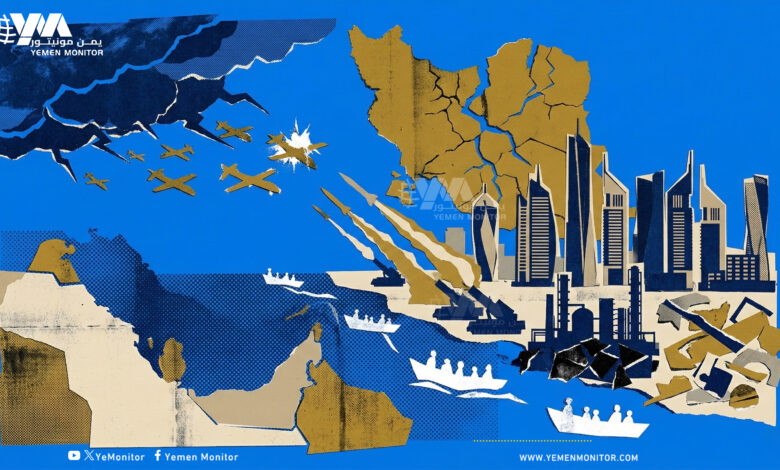
In light of the escalating pace of the US-Israeli war on Iran, the Gulf Cooperation Council (GCC) countries find themselves in the eye of the storm—not merely as strategic observers, but as direct targets for missile attacks and “counter-response” drones.
Former US experts and diplomats indicate that the region is currently experiencing an existential conflict that transcends the military dimension, placing the “Vision 2030” developmental goals in direct confrontation with the legacy of the “Revolution” and regional turmoil, amid urgent questions about the ability of Gulf economic models to withstand an environment that has turned into an open “war zone.”
A Clash of Visions: Developmental Ambitions Under the Threat of Drones
The ongoing conflict represents a decisive test for the economic models developed by Gulf states, particularly the United Arab Emirates and the Kingdom of Saudi Arabia. While the region was looking forward to boosting investments in artificial intelligence and advanced industries, the war has imposed a different reality that recalls traditional security challenges. Experts believe that by targeting all GCC countries, Iran has brought about a kind of forced “strategic convergence” among these nations, which now find themselves facing blatant violations of their national sovereignty.
In this context, Dan Benaim, former US Deputy Assistant Secretary of State, explains that the true essence of the conflict lies in the collision between “Vision 2030” and the spirit of “1979.” Benaim points out that the Gulf states were living a “dream scenario” before the outbreak of the war, with a focus on AI towers, new industries, and global cooperation.
Benaim believes the Gulf states are facing a double blow; on one hand, they are suffering losses in daily energy revenues due to disrupted exports, and on the other, they find themselves forced to bear the costs of protecting their oil facilities from suicide drone attacks. This “economic bleeding” primarily aims to convince Gulf capitals that the price of the continued US-Israeli war on Iran will be very high for their developmental ambitions, which may eventually push them to pressure Washington for restraint and a search for a quick “political exit.”
The transformation of the environment into a conflict zone threatens more than just direct material losses; it strikes at the heart of the “economic model” based on attracting talent and foreign investment, especially in the UAE, which he described as an “economic machine” relying on millions of foreigners and international companies.
For his part, Professor Gregory Gause, a leading American scholar on Middle East affairs, emphasizes that this war lacks any Gulf enthusiasm, as the countries were seeking to maintain calm and stability to achieve their desired economic transformations. He believes that investors and businessmen are “cowards by nature” and do not head toward war zones, making the continued conflict a direct drain on the political and economic capital invested by the region’s countries over the last decade. This threat affects not only facilities but also global confidence in the sustainability of the regional security necessary for the growth of the tourism and finance sectors.
The Equation of Sovereignty: Interception Efficiency and Defensive Deterrence Stakes
On the military front, Gulf states have demonstrated a remarkable ability to deal with sophisticated aerial threats, as air defense systems—particularly in the UAE, Qatar, and Kuwait—have succeeded in intercepting waves of ballistic missiles and drones. This success reflects years of investment in building national defensive capabilities capable of protecting skies and vital facilities. However, the challenge remains in the “arms race” between the high cost of interceptor missiles and the cheap drones launched by Tehran and its regional allies.
Benaim notes with significant appreciation that “Gulf militaries deserve praise for their success in intercepting Iranian attacks,” considering that this reflects massive efforts made over years to build these capabilities. Benaim cites Qatar’s downing of two Iranian aircraft as evidence of the development of specialized military capabilities in the region. Despite this efficiency, concern remains regarding the psychological and social impact of falling debris or fires in urban areas, which changes the daily lifestyle of residents and creates a state of constant anticipation and caution.
Mara Karlin, former US Assistant Secretary of Defense, points out that the success in intercepting missiles is due to years of investment in integrated defense systems, but she warns that “drones” represent a challenge of a different kind. Karlin says: “We are facing a war of attrition; billion-dollar interceptor missiles are used to shoot down cheap drones, and this puts immense pressure on the strategic stockpiles of not only the region’s countries but the United States as well.”
As for the strategic position, Gregory Gause believes the Gulf states find themselves as “policy recipients” rather than “policymakers” in this war, which increases their reliance on the US security partner. Gause warns of the danger of “friendly fire” and confusion in skies crowded with military operations, stressing that Gulf forces will remain very cautious about direct involvement in offensive strikes, preferring to focus on “homeland defense” as a top priority. This delicate balance aims to protect sovereignty while avoiding a slide into a comprehensive confrontation that the region may have no hand in ending.
In this context, an urgent need has emerged to enhance “joint action” among Gulf militaries, which was manifested in the high level of coordination between Saudi Arabia, the UAE, and Qatar in exchanging radar data and early warnings. Despite these successes, anxiety remains over the ability of Iran and its allies, such as Iraqi militias and the Houthis, to launch “saturation” attacks that exceed the capacity of defense systems, placing major urban centers under permanent psychological and security pressure that alters the daily life of the population.
The Nightmare of “Political Vacuum”: Fear of a “Fragmented” Iran
Gulf fears extend beyond the limits of military confrontation to reach the “day after” the fall of the regime in Tehran, especially with news of the absence of supreme leadership and escalating internal unrest. Strategic readings agree that Gulf states prefer dealing with a “weak and contained” Iran over dealing with a “failed state” or one fragmented by ethnicity and militias. The collapse of central authority in Tehran means losing control over a massive arsenal of weapons and the emergence of the risk of millions of refugees flowing across Gulf waters, which would represent a demographic and security pressure exceeding the region’s capacity.
Suzanne Maloney, Vice President of the Brookings Institution, warns that the death of top leaders in Iran could lead to a “dangerous vacuum” that will not be filled by the scattered opposition, but might instead be seized by the most radical wings of the Revolutionary Guard. Maloney says: “The Islamic Republic is founded on repression and has spent decades ensuring no organized civilian alternative exists; thus, the absence of centralization could turn Iran into a permanent hotbed of chaos threatening global navigation and energy security.”
Gause agrees that the worst outcome the war could produce is an Iranian regime that “doubles down” on violence and regional turmoil because it feels it no longer has anything to lose. Therefore, the ultimate Gulf goal remains returning to a path of stability to ensure the completion of the major national projects that began before the crisis erupted.
Experts agree that the best scenario for the Gulf states is reaching an agreement that ensures an “internally stable but regionally declawed Iran.” The fear of a “North Korean Iran” (closed, nuclear, and hostile) or a “Syrian Iran” (deconstructed and filled with militias) drives Gulf capitals to seek a “political exit” that ensures a safe transition of power in Tehran and prevents the war from turning into an earthquake that uproots stability in the Middle East. Dan Benaim confirms that any collapse of central control in Tehran could lead to massive human flows toward Dubai and coastal cities, representing pressure that exceeds the region’s absorption capabilities.
Toward a New Balance
The Gulf states realize that the Middle East after “March 2026” will not return to what it was before. The resilience shown by defensive systems and the political cohesion that emerged in the face of Iranian violations form the cornerstone of any future security arrangements. The greatest stake remains the ability of these countries to neutralize the effects of the military conflict and return the region to the language of economics and development, while ensuring international security guarantees that prevent the recurrence of such confrontations that threaten to squander decades of urban and civilizational achievements.