Yemen Monitor / Reports Unit / Special:
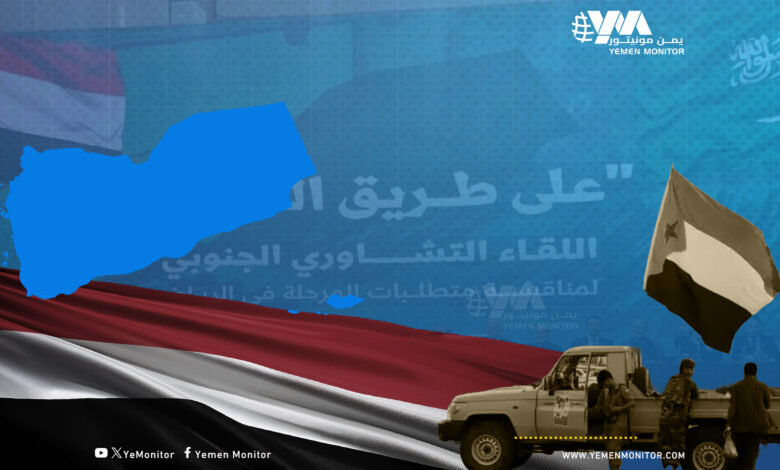
The Saudi capital, Riyadh, witnessed on Sunday the proceedings of the Southern Consultative Meeting, attended by most of the leaders of the (dissolved) Southern Transitional Council. This meeting comes in the context of reorganizing ranks for a specific component representing the secessionist current, in preparation for participation in the broader “Southern–Southern Dialogue” process, sponsored by the Kingdom of Saudi Arabia as a historic opportunity to enhance political partnership.
The meeting included the playing of the former national anthem of the Democratic Republic of Yemen (associated with separatists), a political practice aimed at maturing the vision of the secessionist current and preparing it to engage in comprehensive dialogue as one component among multiple southern forces. The goal is to produce a consensual vision for the southern and eastern issue of the country.
Coordinating Positions as an Entry Point to National Partnership
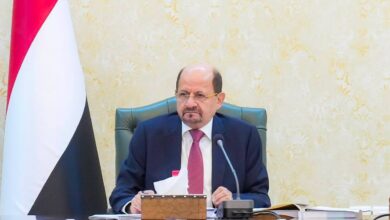
In this context, Yemeni Presidential Leadership Council member Abdulrahman Al-Muharrami (Abu Zaraa) affirmed that this path represents a “rare historic opportunity that must not be squandered.” In the closing statement, Al-Muharrami explained that the Saudi position “supports and fully aligns with the just demands of our southern people, and supports their right to find a comprehensive political solution that guarantees dignity, security, and stability.”
For his part, Yemeni writer and political analyst Abdul Sattar Al-Shamiri believes that this meeting represents “a first step toward salvation.”
Al-Shamiri pointed out that the importance of this step lies in “building real foundations in which reason and vision are present, while the language of force and imposing any vision at gunpoint is absent.” He stressed that this organizational framework paves the way for “a rational, balanced southern dialogue that believes in realism,” placing shared interests above narrow factional considerations.
Saudi Arabia plays a pivotal role as the sponsor of this approach. Saudi political writer Salman Al-Sharida described the Kingdom’s role as a “political and moral safety valve.” He emphasized that the Kingdom seeks to achieve Yemen’s stability by supporting “transparent dialogue among all leaderships.” He also noted that Riyadh’s hosting of the meeting reflects a belief that “dialogue is the only way to achieve all goals that fulfill the hopes of peoples.”
Al-Sharida said that projects hostile to Yemen are the ones that benefit from the continuation of chaos and view dialogue as a threat.
He explained that the Kingdom seeks to create a comprehensive solution that guarantees the rights of all Yemeni components, stressing that success in this track requires overcoming points of disagreement and showing flexibility in achieving the public interest. He affirmed that the ultimate goal is Yemen’s stability in line with the legitimate demands of the Yemeni people in both the south and the north.

Political Pluralism and Rejection of Exclusive Representation
The consultative meeting is based on a firm conviction that the participating party is one component among many, not an exclusive representative or sole spokesperson for the south. In the statement read by Abu Zaraa Al-Muharrami, there was a clear affirmation that there is “no intention whatsoever to exclude or marginalize any southern individual or party.” He stressed that this path “is based on broad partnership and responsible representation within the south,” enhancing the legitimacy of national outcomes.
Analyzing the diverse southern landscape, Deputy Head of the Yemeni Scholars Authority and advisor to the Presidential Leadership Council, Dr. Mohammed Al-Ameri, explained that the scene features “multiple visions for resolving the southern issue in a way that ensures the lifting of injustice and marginalization.”
Al-Ameri noted that some see unity in its centralized form, others in a federal form, and others call for secession. He affirmed that “all these visions will be discussed and presented, and what they ultimately agree upon will be the solution acceptable to all.”
This diversity reflects the essence of the dialogue facilitated by the Kingdom. Abdul Sattar Al-Shamiri explained that “this open framework for presenting visions without rejecting any opinion makes everyone bound by the process.”
He added that the Saudi vision is based on the principle that “everyone should be present, each with their own ceiling,” relying on democratic and consensual mechanisms that ensure that “the opinion of the majority prevails, while listening to all views, even those of the minority.”
Messages of Assurance Toward an Inclusive Future
The Riyadh meeting sends a clear message of reassurance that any future path will not be confined to a single party, but will remain open to the participation of all southern forces and figures. In this regard, Abu Zaraa Al-Muharrami warned against attempts to “manufacture internal southern disputes or antagonize the Kingdom.” He stressed that the goal is to build a future “without imposing prior conditions or political ceilings,” in a way that guarantees the people’s right to determine their political future.
Salman Al-Sharida also emphasized the importance of participating forces investing in Saudi sponsorship, which “has no ceiling in providing all forms of support.” He explained that the Kingdom believes the southern issue is “a just cause,” but that the solution must pass through “consultations that include all spectrums, rather than domination through weapons or the imposition of force by certain parties.” He noted that any attempt to obstruct this path serves only “external projects that do not want Yemen to be stable.”
He added that the Kingdom deeply understands the importance of Yemen’s stability as a brotherly neighboring country, and has a long history of diplomatic contributions from the 1994 crisis through the Abha and Riyadh consultations. He affirmed that “the Kingdom believes dialogue is the only way to reach the desired goals, away from the monopolization of power through force of arms.”
To ensure that these understandings are translated into tangible reality, Abdul Sattar Al-Shamiri called for the need to set timelines for outcomes, saying: “Setting timelines for the outcomes of any meeting is what we should emphasize… put what you agree on into a specific timetable with guaranteed assurances.”
Dr. Mohammed Al-Ameri concluded by stressing that “sound knowledge based on a moderate, centrist approach is the guarantee and safety for society” against deviant ideas that may hinder the path toward consensus and stability.