Yemen Monitor / Reports Unit / Exclusive:
Residents of the Al-Tahrir neighborhood in Yemen’s capital, Sana’a, are living in tragic conditions after the recent Israeli airstrikes that hit the area a few days ago. Until now, they have received no communication or directives from the Houthi group regarding their fate or the possibility of alternative housing, as they continue to tend to their own wounds amidst the rubble of their destroyed homes.
Dozens of families have found themselves facing two bitter options: remaining in the open or dispersing among the homes of relatives. So far, the Houthi authorities have not presented any plans for reconstruction or emergency support.
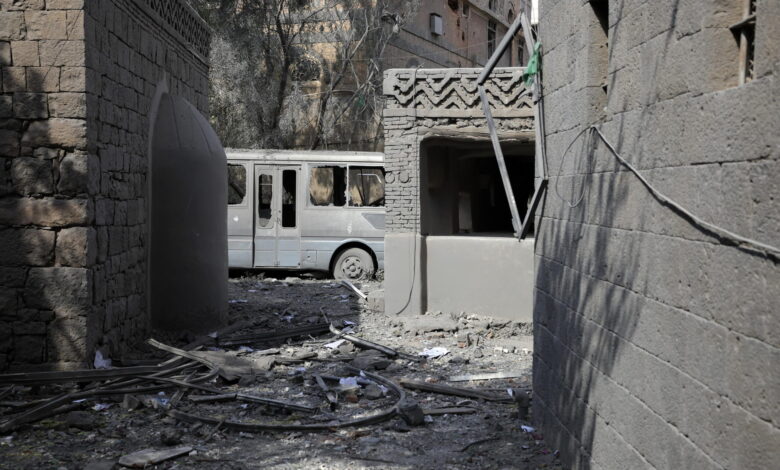
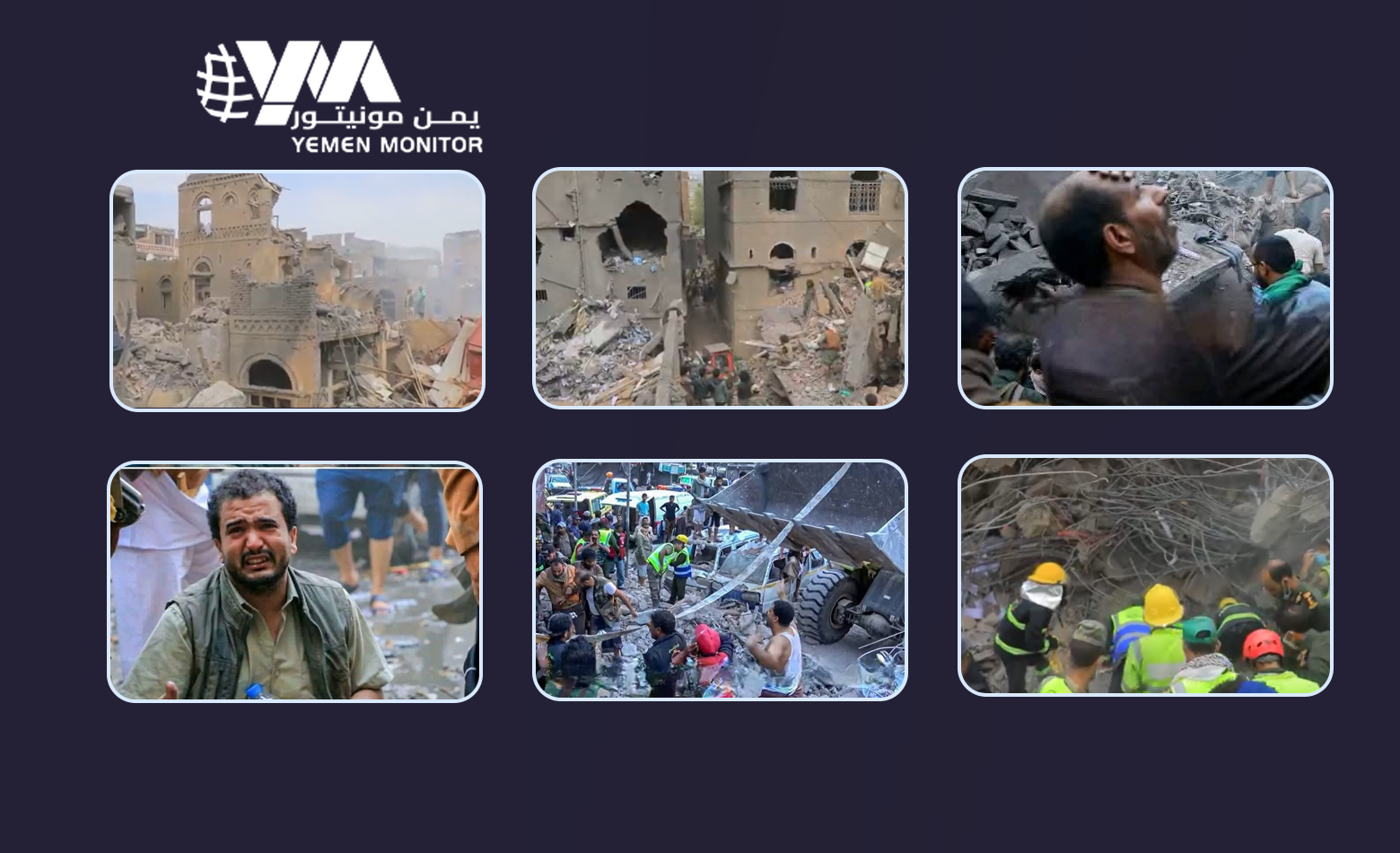
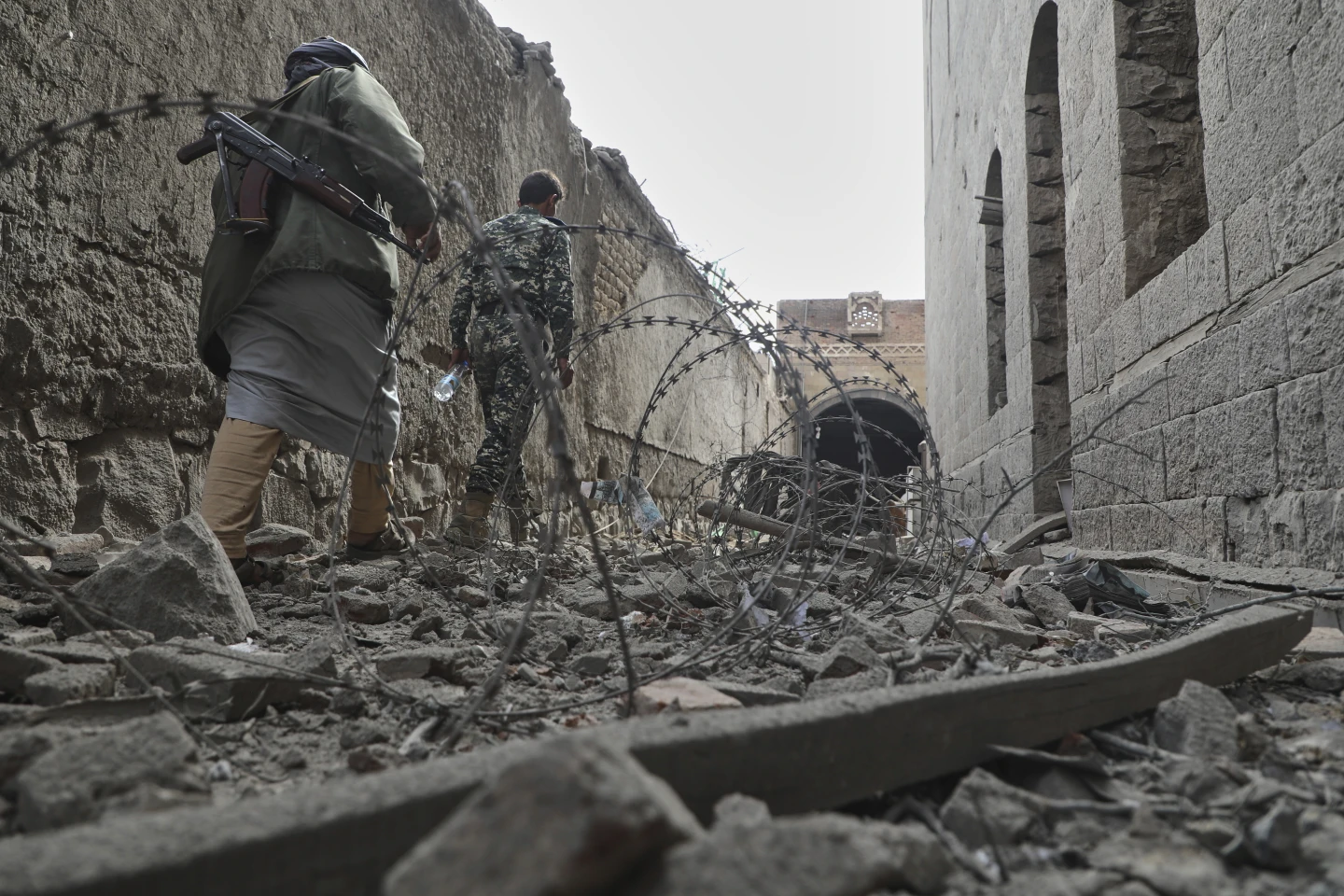
The once lively neighborhood has turned into a heap of rubble, impossible to distinguish from beginning to end, while civil defense teams and local volunteers continue searching for the bodies of victims trapped under the ruins.
According to medical sources who spoke to Yemen Monitor, around 43 people were killed in Sana’a alone, and more than 150 others injured. Four buildings were completely destroyed, while most homes in the neighborhood suffered partial damage, forcing mass displacement of residents.
The silence of the authorities
Reema Abdul-Aleem, one of those affected by the Israeli strikes and whose three brothers were injured, said:
“We all fled with the injured to relatives’ homes. Fifteen members of my family were scattered across the larger family’s houses. We have not received a single call from the authorities to discuss our situation or how our home might be rebuilt.”
She explained to Yemen Monitor that her brother repeatedly contacted the Houthi neighborhood official (“aqil al-hara”), who told him that higher officials “do not answer phone calls.”
Holding back her tears, Reema added that she stopped going to work at a small company near her home:
“My psychological state is terrible. I feel like I’m still under the rubble, with dust in my ears and eyes. Since the attack, I’ve been crying.”
Although she recognizes that her family’s survival is a miracle compared to their neighbors who perished under the rubble, her shock is deepened by what she described as “official indifference.”
“They won’t fix anything”
Saleh Hameed, another resident, recounted that he and his family were outside their home at the time of the strike. When he returned, all he found were collapsed walls and a destroyed kitchen.
He told Yemen Monitor:
“We lost everything in the blink of an eye. The house I spent my whole life saving money for no longer exists.”
When asked about the possibility of the Houthis repairing the destruction or providing compensation, Hameed scoffed:
“They won’t fix anything. No one trusts them. I’ll take out a loan, fix the house myself, and move back in.”
He confirmed that the authorities never contacted him, adding, “And they never will.”
In addition to hitting the neighborhood, the Houthis announced that the airstrikes targeted the headquarters of a military newspaper run by their forces, a fuel station in Sana’a, and a government facility in Al-Hazm city, Al-Jawf province. The Yemeni National Museum was also damaged, with social media photos showing parts of its facade destroyed.
Hospitals under pressure
The crisis extended beyond the devastated neighborhood to hospitals struggling to cope with the large number of injured amid severe shortages in resources and staff.
A doctor at Kuwait Hospital told Yemen Monitor:
“We don’t have enough surgeons, doctors, or emergency departments, nor do we have enough nurses.”
He noted that the Houthi authorities had “refused to renew medical equipment and operating rooms for years despite repeated demands. We don’t have the means to provide services to ordinary patients, let alone victims of a brutal missile strike.”
A senior official at Al-Jumhuri (Republican) Hospital, located near the site of the strike, said the situation was “very bad.”
“Dozens of patients are lying in the hospital with limited resources. We suffer from shortages in medicine and painkillers, and the government has slashed the hospital’s budget.”
The Republican Hospital, already under heavy strain, has been further pressured by the suspension of international organizations’ operations and clinics in neighboring districts and provinces.
The hospital official added:
“The Zakat Authority cut most of our budget weeks ago. The situation is dire.”
Yemen Monitor was unable to obtain an immediate comment from the Houthi Ministry of Health or the Sana’a Municipality.
Fear of the Houthi retaliation
Officials and other sources interviewed for this report expressed fear of retaliation by the Houthis, who impose strict censorship over casualty information and prevent independent media from speaking to victims.
The Houthis control the narrative, leaving the true scale of the Israeli strikes — regarded as a war crime — shrouded in uncertainty.
Despite the media blackout, videos and photos of the strike site spread across social media, though they failed to capture the “full extent of the tragedy.”
Thus, the residents of Al-Tahrir neighborhood remain caught between the devastation of losing their homes and loved ones, and the indifference of the de facto authorities who have not offered even the most basic forms of support or solidarity. Their stories stand as testimony to destruction that cannot be erased by speeches, nor healed by silence.