Yemen Monitor / Aden / Special:
The temporary Yemeni capital, Aden, is witnessing rapid security developments amidst a security vacuum that followed sovereign decisions issued by the Presidential Leadership Council. This coincides with field movements by “National Shield” forces and a widespread deployment of “Giants” forces across several government institutions and facilities.
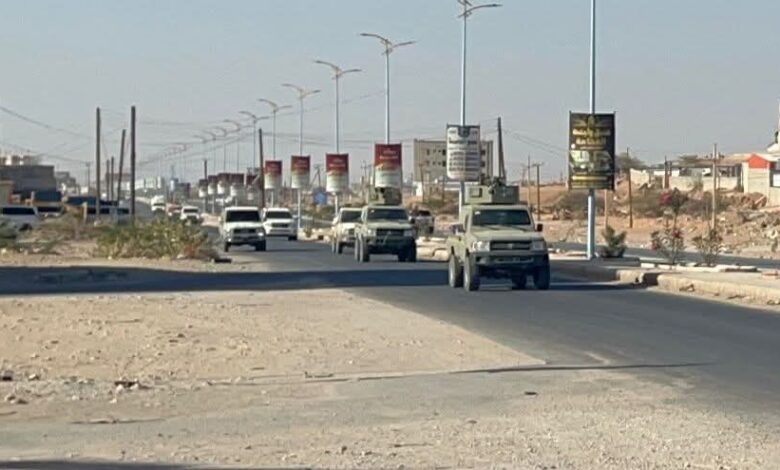
Local sources reported on Wednesday that vanguards of the “National Shield” forces had arrived at the Oqla intersection in Shabwa province, on their way to the temporary capital, Aden. These military movements aim to impose a new security reality in the liberated provinces and implement the Presidential Leadership Council’s decisions regarding unifying command and control and preventing any armed movements outside the state’s framework.
According to the sources, large military convoys of “National Shield” forces were seen heading towards Aden, hours after presidential decisions were issued to revoke Aidarous Qasim al-Zubaidi’s membership in the Presidential Leadership Council and refer a number of military leaders to trial on charges of rebellion and high treason.
According to informed sources, these reinforcements aim to support local authorities in imposing public order, securing government and private facilities, and preventing any security repercussions that may arise from recent political developments, amid indications of declining security control within the city.
Deployment of Giants Forces
In the same context, a security source reported that Giants forces were deployed on Wednesday across several districts of the capital, Aden, to support security agencies in protecting sovereign facilities and government institutions, as part of a coordinated security plan aimed at maintaining security and stability.
The source explained that the Giants forces participated in securing Ma’ashiq Palace, Camp 20, and the Central Bank in the Seera district, in addition to Al-Nasr Camp in Khormaksar, the Governorate building in Al-Mu’alla district, along with other sites and security checkpoints. The source affirmed that the deployment comes within the framework of comprehensive precautionary measures to protect public tranquility and prevent any security collapse.
These movements come at a time when reports have increased about Aidarous al-Zubaidi leaving the capital, Aden—a claim denied by Amr Al-Baidh, the STC’s representative for foreign affairs. He confirmed that Al-Zubaidi is still present in Aden and continues to perform his duties, although he acknowledged the presence of a council delegation in Saudi Arabia to follow up on negotiations.
In contrast, Saudi Arabia previously announced that Al-Zubaidi was scheduled to travel to Riyadh but did not board the plane, accusing him of gathering weapons and armed men and fleeing—a development that has heightened political and security tensions in the southern provinces.
In a related context, Abdullah Al-Alimi, a member of the Presidential Leadership Council, expressed regret over the security tensions in the southern provinces, considering what is happening as a “restoration of the state’s standing, its institutions, and its legitimacy.” He called on all political and media forces to exercise national responsibility and prioritize the public interest.
Amidst these developments, Coalition aircraft have carried out airstrikes in recent days targeting camps and weapons depots in Al-Dhale and Hadramawt provinces, following accusations of smuggling weapons from the temporary capital, Aden, to areas outside it. According to local sources, this has led to escalating fears of widespread security breakdown.
Local reports indicated that the airstrikes coincided with a clear decline in the role of security agencies and looting of weapons depots and public institutions. Warnings have been issued that this security vacuum may pave the way for a resurgence of extremist groups, foremost among them Al-Qaeda, especially in areas that have previously witnessed the organization’s presence in recent years.