Yemen Monitor/ Reports Unit/ Exclusive:
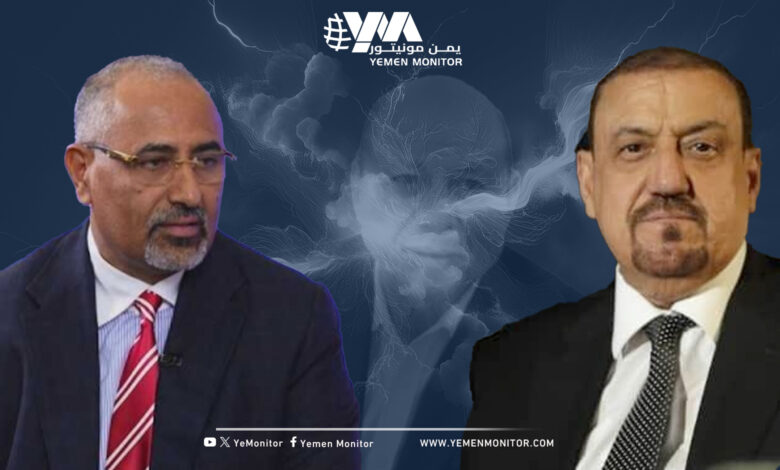
The temporary capital, Aden, has recently witnessed a sharp and unprecedented escalation in disputes between Sheikh Sultan Al-Barakani, the Parliament Speaker, and Aidarous Al-Zubaidi, a member of the Presidential Leadership Council and head of the Southern Transitional Council (STC). This conflict, which began beneath the surface with “oversight” moves by the Parliament, has exploded into a war of statements and accusations, revealing the depth of the rift within the camp of the internationally recognized government and its allies.
This escalation highlights the conflicting agendas between the “constitutional legitimacy” current represented by Parliament and the “de facto authority” current led by Al-Zubaidi, with clear Emirati support that is turning Aden into a flashpoint for the fragile entity of the Yemeni state.

Al-Barakani’s Attack
Two sources who attended the Parliament Speaker’s meetings confirmed to Yemen Monitor that Sheikh Sultan Al-Barakani launched a sharp and direct attack on Aidarous Al-Zubaidi, describing him as “the stupid and imbecile” and “unqualified to hold any leadership position in the state.”
This anger came as a direct reaction to the “unilateral” decisions issued by Al-Zubaidi last September, involving extensive appointments in sovereign and government institutions that fall under the powers of PLC Chairman Rashad Al-Alimi. Al-Barakani considered these decisions a “attempt at expansion and undermining legitimate authority and the unity of sovereign decisions at the expense of the state, national interest, and the country’s unity.”
According to the two sources, Al-Barakani’s remarks were made during a qat-chewing session two days after Al-Zubaidi issued his decisions. During the session, the Parliament Speaker expressed his readiness to bear the consequences of this position and state it publicly, stressing that “the era of silence is over and the facts must be revealed to the people,” indicating that the disagreements have reached a point of no return.
On October 13, the Parliament’s Presidium issued a statement denying that Al-Barakani had described Al-Zubaidi with these terms. However, it directly accused journalists, describing them as “the stupid and imbecile,” which is seen as shifting responsibility without denying the essence of the dispute.
The two sources spoke on condition of anonymity due to the sensitivity of the subject.
The Roots of the Disputes
The roots of the public confrontation lie in the ST C’s continued refusal to allow sessions of the Yemeni Parliament to be held in Aden province, which the STC controls as a de facto authority. However, the disagreements escalated following moves made by Parliament, under Sheikh Al-Barakani’s leadership, since last July to perform its oversight role on the government’s performance and the integrity of public revenues.
On July 1, Al-Barakani met with PLC Chairman Rashad Al-Alimi and Prime Minister Salem bin Breik where they agreed to form parliamentary committees to work in the “liberated” provinces.
These committees were tasked with sensitive missions including: studying and monitoring the failure to pay salaries, providing services, and investigating the “systematic looting” of revenues by some entities that do not remit the amounts to the public treasury, in addition to curbing the “arbitrary actions of influential forces.”
The Parliament’s committees arrived in Hadhramaut and Marib provinces on July 19. But in Al-Mukalla (the capital of Hadhramaut), groups affiliated with the STC besieged the committee’s headquarters for two days and threatened to storm the hotel, disrupting its work and forcing it to leave on July 21. Meanwhile, the committees continued their work warmly in Marib province.
The suspension of the committees’ work in areas under STC control (most southern provinces) is seen as material evidence that the STC’s goal is to prevent any oversight of financial activities in the areas it controls, especially in Hadhramaut, which is a treasury for oil and customs revenues. Al-Zubaidi also heads the “Supreme Sovereign and Autonomous Revenue Committee,” a committee that has remained inactive since its formation three years ago, reinforcing accusations by Parliament members of obstructing revenue oversight to allow the continuation of “arbitrary actions by influential forces” and the systematic looting referred to by Parliament.
After the committees’ work was suspended, the Parliament’s Presidium said: “The Presidium of the Council affirms the continuation of its efforts to enable the Council to convene permanently in the temporary capital Aden and for the Council to perform its constitutional and legal duties.”
The Presidium of the Parliament Council affirmed that it “will remain in its position, believing that the Council of Parliament is the only existing constitutional and legitimate authority, and that it will exercise its duties until new elections are held in accordance with the provisions of Article (65) of the Constitution and Article (4) of the Council’s bylaws, which gave it the right to continue in the event of force majeure circumstances, and elections are held after those circumstances cease.”
Leadership Paralysis and the Future of Institutional Collapse
If the ignoring of Parliament’s decisions – which “cannot be used selectively” – continues, along with unilateral decision-making and explicit threats of secession, this fundamentally undermines the constitutional and legal foundations upon which legitimacy in Aden is based.
What the disputes between the Parliament Speaker and the STC leader have revealed is not merely a disagreement over powers, but an existential conflict between constitutional legitimacy and de facto authority supported by the UAE. This creates deep institutional paralysis, especially with the paralysis of the Presidential Leadership Council and the Yemeni government due to power struggles.
The disruption of parliamentary committees and preventing them from monitoring revenues indicates a systematic slaughter of constitutional oversight and the shielding of financial corruption that threatens the survival of state institutions, particularly amid the severe salary crisis since last June. The monopolization of presidential decisions by Al-Zubaidi, and the subsequent abject failure of the Presidential Leadership Council to review or cancel these violations within the ninety-day deadline, entrenches the state of complete paralysis of the highest authority in the country.
Amid this escalating institutional paralysis, the chances of addressing vital crises such as the currency collapse and the halt of salary payments diminish, pushing legitimacy towards self-destruction. The continuation of this conflict between “constitutional unity authority” and the “regionally supported secession agenda” threatens to turn “liberated” areas into a new focal point for internal armed conflict, undermining any serious efforts to restore the state and dooming the comprehensive national project to failure.