Yemen Monitor / Aden / Exclusive
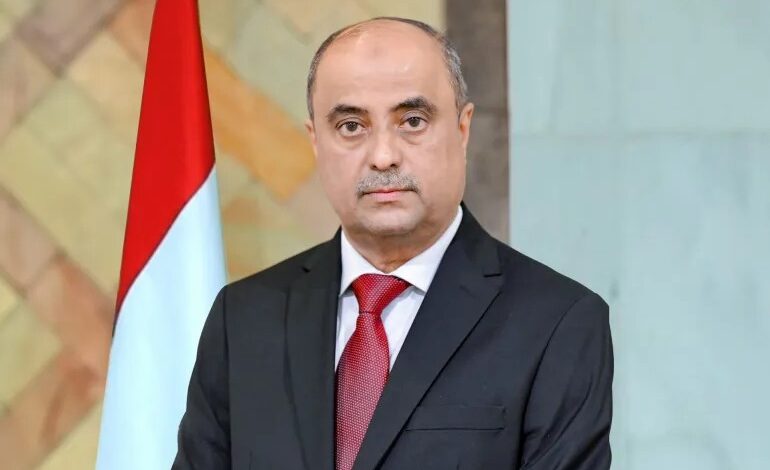
In an extensive interview outlining the Yemeni government’s strategy to address economic collapse, Prime Minister Salem bin Buriek affirmed that rescuing the national currency from the “depths of collapse” and restoring about 30% of its lost value came as a result of “tough decisions and financial discipline,” not mere “slogans.”
Bin Buriek, in remarks to Asharq Al-Awsat, stressed that the success of the reform path depends on empowering the government to fully exercise its authority without obstacles, with support from the Presidential Leadership Council.
He explained that the recent improvement in the exchange rate of the Yemeni rial, which coincided with a decline in inflation rates, was not a “coincidence” but rather the outcome of integrated fiscal and monetary policies and the implementation of a package of “exceptional and bold” measures. Among the most notable of these measures were: establishing the National Committee for Regulating and Financing Imports to enforce transparent mechanisms, banning the use of foreign currencies in the domestic market, rationalizing public spending and enhancing revenues, and forming the Higher Committee for preparing the 2026 state budget—a step not taken in years.
The Prime Minister affirmed that these measures successfully curbed speculation and reduced demand for foreign currency, proving that institutional reforms can make a difference even amid the greatest challenge: the suspension of crude oil exports, which had accounted for 65% of public revenues. He warned that the Houthi militia is waging a “systematic economic war,” using the economy as a weapon to undermine the state and deepen the humanitarian crisis.
Bin Buriek praised the recent Saudi financial package amounting to 1.380 billion Saudi riyals (approximately 368 million US dollars), stressing that it came at a “critical moment” to reinforce monetary stability. He considered this support to go beyond its direct financial impact, serving as a “reassuring message to Yemenis first, and as regional and international confidence second,” affirming that the Kingdom had “placed its weight behind Yemen at a crucial juncture.”
He pointed out that Saudi support represents a “qualitative shift” aligned with reforms, calling on other allies and partners to take similar stances to support the government in its plan to move from “crisis management” to “solution-making.”
Call to the International Community: From ‘Concern’ to ‘Deterrence’
Bin Buriek urged the five permanent members of the UN Security Council to move from “statements of concern” to “practical steps” that would give the government stronger tools to restore the state. In this context, he called on the UN envoy to show “greater clarity and explicitly name the spoilers,” noting that Houthi intransigence stems from the Iranian regime’s rejection of peace. He stressed that the U.S. administration’s decision to re-designate the Houthis as a “Foreign Terrorist Organization” is an important step that other countries should follow.
The Prime Minister emphasized that peace is the government’s strategic choice, but it depends on having a “serious and responsible partner” and implementing the three agreed-upon references, foremost among them Resolution 2216. He noted that any successful political approach is contingent on “ending Iranian influence that destabilizes regional and international security.”
The Government’s Plan
The Prime Minister revealed the government’s determination to move forward with the implementation of the 2025–2026 Economic Recovery Plan, approved by the Presidential Leadership Council, which focuses on structural and fundamental reforms to ensure sustainable economic improvement. The key pillars of this plan include: strengthening financial discipline and transparency in public spending, continuing tax and customs reforms to increase sustainable revenues, and empowering the private sector to lead the development process.
Bin Buriek affirmed that the ultimate goal is to restore citizens’ trust by transforming reforms into “tangible practical steps” in services and living stability, reiterating that the government’s success depends on “strong political backing” from the Presidential Leadership Council that guarantees it full authority.