Yemen Monitor/Newsroom:
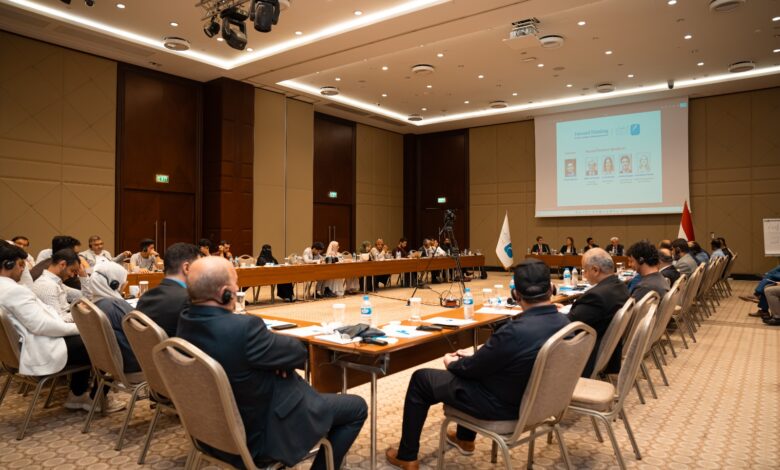
The Al-Makha Center for Strategic Studies, in partnership with the Forward-Thinking Foundation, held an extensive symposium in London titled “Yemen Amidst Current Regional and International Transformations.” The event featured a selection of researchers and experts from both inside and outside Yemen.
The symposium explored the root causes and internal and external drivers of the Yemeni conflict, the regional and international shifts tied to it, and societal issues like the role of women in the peace process and how Yemen is portrayed in Western media. The event concluded by presenting different scenarios for the country’s future.
Participants included Dr. Ismail Al-Suhaili, a professor of political science and a senior researcher at Al-Makha Center; Oliver McTernan, a British expert and head of the Forward-Thinking Foundation; Dr. Ahmed Ramadan, Director General of the London Center for Media Strategies; Ateq Jarallah, head of Al-Makha Center; along with Cecily Bayliss, WFS Program Director; Anna Bailey-Morley, Middle East Program Officer at Thinking Forward; and Jordan Morgan, Program Manager at the same foundation.
In his opening remarks, Dr. Al-Suhaili addressed the roots of the conflict, noting that the rule of imams under the pretext of divine selection created successive crises. He pointed out that the Houthi group exploited internal factors and external support to stage a coup in September 2014. He added that the war continues due to Houthi intransigence, the weakness of the internationally recognized government and the conflicts within its components, in addition to regional and international interventions.
British expert McTernan provided an in-depth analysis of the conflict’s mechanisms, warning that a “peace through force” philosophy only produces a fragile peace. He stressed that the path to stability requires justice and dialogue. He criticized Israel for using conflicts to serve its ideology, with support from the U.S. administration.
Dr. Ahmed Ramadan highlighted the impact of international conflicts on Yemen, mentioning three major conflicts that are reshaping the global order: between Russia and the West, between China and the U.S., and between Europe and the U.S. He explained that these tensions are reflected in the region and in Yemen, which remains excluded from development opportunities due to its instability.
In a discussion about the crisis’s future, Ateq Jarallah noted that the Yemeni issue has transformed from an internal crisis into an international one. He proposed three potential scenarios for the conflict, with the most prominent one being a broader regional and international intervention that would reshape the landscape.
Cecily Bayliss emphasized the need to empower Yemeni women and include them in the peace process, highlighting the double burden they bear because of the war, especially amid the collapse of basic services.
Anna Bailey-Morley discussed Yemen’s image in Western media, explaining that coverage often focuses on the geopolitical dimension, neglecting the voices of Yemenis and their humanitarian suffering, which has contributed to the marginalization of the issue.
Jordan Morgan warned against attempts to frame the conflict in religious and ideological terms, arguing that this exacerbates divisions. He called for reviving the national dialogue and strengthening civilian leadership.
In conclusion, the speakers affirmed that Yemen is no longer just a local crisis but a complex knot in a web of regional and international conflicts. They stated that sustainable peace will only be achieved through justice, national partnership, and the building of a state capable of leveraging the country’s strategic location instead of remaining an open battlefield.