UNICEF: Yemeni Children’s Determination to Learn Inspires Humanitarian Efforts

Yemen Monitor – Newsroom:
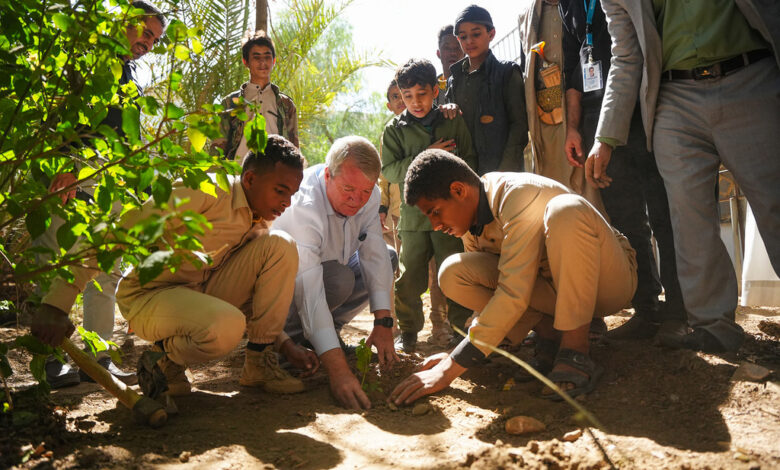
Despite years of conflict, poverty, and destruction, Yemeni children’s determination to continue learning is a powerful source of inspiration for humanitarian work, according to UNICEF’s representative in Yemen, Peter Hawkins.
In an interview with Melissa Fleming, UN Under-Secretary-General for Global Communications, on the award-winning podcast “Awake at Night”—which delves into the personal challenges faced by UN officials and humanitarian workers—Hawkins reflected on his two and a half years in Yemen.
He described the harsh reality of children living in poverty, visible in their weary eyes, dust-covered hair, and frail skin, while many schools remain in ruins. Yet, he said, children continue to attend makeshift classrooms without walls, floors, or desks, proudly showing what they have learned. “They tell me, ‘Look, don’t worry. We’ll keep learning. But if you can give us desks, build walls, lay a floor, and put up a blackboard, we’ll do even better,’” Hawkins recalled.
Over the past three months, UNICEF has distributed 23,000 desks in northern Yemen and rehabilitated 1,116 schools as part of a nationwide education program. Hawkins described visiting a completely destroyed school where boys and girls studied side by side—an uncommon sight—under a roof held up by a single pole. Still, he said, the children were smiling and learning. Outside, he found 12 eleventh-grade girls sitting under a tree with a blackboard strung nearby, one of them holding her baby.
Hawkins cited the collapse of Yemen’s banking system as the greatest obstacle facing UNICEF’s work in recent years, alongside the detention of UN staff and ongoing security concerns. With shrinking funds and declining humanitarian aid, he emphasized the need to prioritize so that the most vulnerable children, women, and families can continue to receive support.
Reflecting on the roots of his inspiration, Hawkins spoke of his upbringing in Ethiopia, where his parents—chartered accountants from East London—ran an auditing firm that served charitable organizations, including a hospital treating women with fistula. As a young man, Hawkins managed the hospital’s accounts, later joining its board after his father’s death. This early experience, he said, gave him a unique blend of business skills and a commitment to humanitarian service.
After studying in London, he returned to Ethiopia to work during the devastating famine in the north, where he learned that “success is possible in saving lives.” Ethiopia, he said, continues to shape his values and motivation.
Before joining UNICEF in 2015, Hawkins worked with the British government, where he was drawn to multilateralism—one of the guiding principles behind the creation of the UN in 1945. Despite criticism of the system today, he defends it as the best framework for responding to crises and hopes that a future global order will renew or adapt these values.
Hawkins also recalled his time in Iraq after the fall of ISIS in Mosul, when he saw two children playing outside for the first time in years after being confined indoors. He followed them home to their grandmother and spoke with them, realizing that—even after years of isolation—they had rediscovered hope and recognized goodness in the world.
One of his most searing memories, he said, was from Korem, the epicenter of Ethiopia’s famine, where he saw grieving families carrying their loved ones’ bodies through tented camps every day. Such experiences, he added, reinforced his focus on prevention: “How can you stop this from happening tomorrow?”
For Hawkins, every day is a chance to contribute to making the world a better place. “I’ve been lucky in life,” he said.