Yemen Monitor / Newsroom:
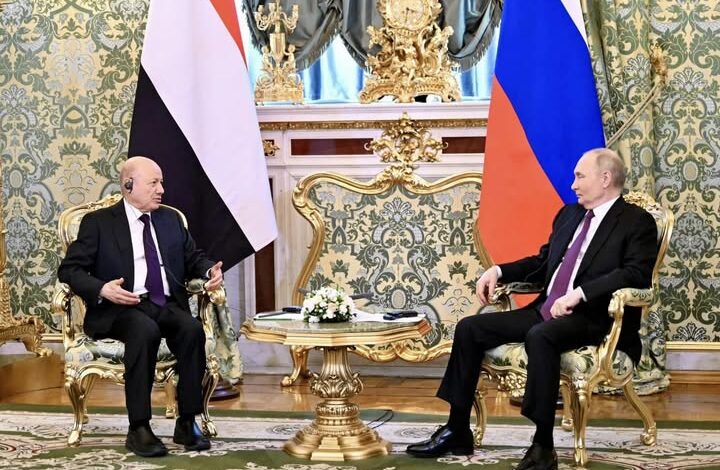
A policy paper issued by the Mocha Center for Strategic Studies revealed that the visit by Rashad Al-Alimi, Chairman of Yemen’s Presidential Leadership Council, to Moscow in late May marked an unprecedented strategic shift in the rhetoric of Yemen’s internationally recognized government. The visit, the paper argues, went beyond formal protocol and carried multi-dimensional political, security, and economic messages.
The paper highlighted that Al-Alimi’s meetings with Russian President Vladimir Putin and other senior officials were accompanied by a notable delegation, including advisers on defense, reconstruction, and culture. This, it noted, signaled a clear Yemeni intention to broaden cooperation with Moscow across security, economy, culture, and politics.
Of particular significance was the presence of Major General Mahmoud Al-Subaihi, Al-Alimi’s defense adviser, which the paper interpreted as an indication that Yemen’s government is seeking Russian military support—especially in air defense—amid declining backing from some traditional regional allies.
Likewise, the inclusion of Reconstruction and Development Adviser Eng. Omar Al-Amoudi reflects an interest in reviving Russia’s historical role in Yemen’s post-war reconstruction, dating back to the period following the 1962 September Revolution.
On the political front, the paper noted that Al-Alimi’s appearance on Russia Today marked a shift from a defensive to a more assertive stance. During the interview, he described the Houthi group as “a Nazi movement,” aiming to resonate with the Russian public’s deep-rooted historical sensitivity toward Nazism. The paper interpreted this as a deliberate propaganda strategy aligned with Moscow’s official rhetoric opposing any groups labeled as Nazi-like.
The timing of the visit is also noteworthy, occurring amid growing signs of rapprochement between the Houthis and certain Russian circles, including increased meetings between Houthi leaders and Russian officials. According to diplomatic sources, the visit aimed to counter the narrative the Houthis are trying to promote within Russian political circles by presenting the internationally recognized government’s version of the conflict.
In his interview, Al-Alimi stressed Yemen’s urgent need for advanced air defense systems and called for direct Russian support. At the same time, he reaffirmed the legitimate government’s commitment to international peace frameworks in contrast to what he described as a group “that does not believe in peace.”
Al-Alimi also met with the Speaker of the Russian State Duma, research institute representatives, and diplomats, in a bid to reinforce Russia’s official support for Yemen’s legitimate government and to encourage Moscow to play a more active role in curbing Houthi expansion.
Despite the diplomatic momentum, the analysis warned against certain statements made by Al-Alimi—particularly his claim that “Yemen is under Chapter VII”—arguing that such remarks may be inaccurate and legally or politically misleading, given that UN sanctions specifically target the Houthis, not the internationally recognized government.
The paper concluded that the visit represents an effort by Yemen’s government to reposition itself geopolitically through the Russian gateway. However, its success will depend on the government’s ability to follow up on the visit’s outcomes and turn agreements into tangible support in security, reconstruction, and national sovereignty.
The Mocha Center noted that Al-Alimi’s visit reflects a shift in the legitimate government’s policy toward clearer political messaging and a stronger national narrative at a time when Russia is attempting to balance its relationships with all key actors in Yemen—including Iran, with whom it shares strategic interests.
While the visit may open the door to greater Russian support—particularly in energy and infrastructure—the paper concluded that Russia’s stance, though outwardly supportive of Yemen’s legitimate government, will ultimately remain shaped by Moscow’s complex regional interests.
The policy brief ended by stressing that the success of the visit hinges on the Yemeni government’s ability to build on it through the formation of joint committees, the implementation of agreements, and the transformation of Russian promises into concrete actions that strengthen Yemen’s presence in Russian foreign policy and bolster the legitimacy’s position on the international stage.