Yemen Monitor |Reporting Unit :
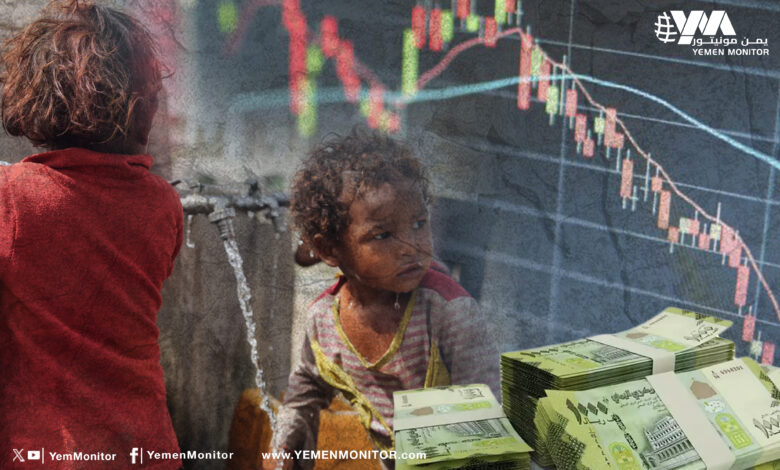
Yemen is currently grappling with a severe economic crisis, as the exchange rate of the Yemeni riyal has surpassed 2,500 riyals per U.S. dollar and 670 riyals per Saudi riyal. In recent months, rates had remained below 2,500 to the dollar and 540 to the Saudi riyal. This sharp depreciation has deepened the suffering of millions of citizens living below the poverty line.
In this context, the Head of the Presidential Leadership Council issued a decree appointing Salem bin Brik as Prime Minister, with economic experts cautiously expecting short-term stabilization in currency markets.
Experts pointed to political disputes between the previous government and the Presidential Council as a key factor in the currency’s decline, noting that exchange rates have become a tool of political pressure.
Protests Reflect Public Anger
Amid this deteriorating situation, large-scale protests erupted in the city of Aden, expressing outrage over worsening living conditions.
Protesters called on the government to act urgently to stop the currency collapse and improve infrastructure services.
Causes of the Crisis and Government’s Position
The Yemeni government attributed the financial crisis to the halt in oil exports since October 2022, due to Houthi attacks on oil ports. The Houthis have insisted on sharing oil revenues to pay public sector salaries.
Economic expert Salman Al-Muqrani told Yemen Monitor that, “The economic collapse threatens social and political stability. A new horizon must be opened for the poor and middle class, or wars and crime will persist.”
Record High Food Prices
Amid the economic downturn, food prices have soared to unprecedented levels. A 50-kg sack of flour in Taiz now costs around 59,000 riyals, up from 47,000–51,000 riyals. A 10-kg bag of rice has risen to 30,000 riyals, up from 25,000 just a week earlier. These spikes have further strained families, forcing many to reduce their consumption to bare essentials.
Voices from the People
Naamatullah Mohammed, a resident of Taiz, shared her struggles with Yemen Monitor, saying, “Even though both my parents work full time, they can’t afford all the necessities—we’re limited to the bare minimum.”
She added that the soaring food prices have made meeting basic needs extremely difficult, increasing pressure on households and threatening their food security.
Hardship in Aden
Fawaz Al-Muqtri, a schoolteacher in Aden, described his daily struggles to meet basic needs.
Speaking to Yemen Monitor, he said his monthly salary doesn’t exceed 80,000 riyals—equivalent to just 115 Saudi riyals at the current exchange rate. “How am I supposed to live on this?” he asked, noting that his salary once equaled over 1,500 Saudi riyals.
He described the economic situation as “catastrophic,” voicing concern that the crises will worsen amid the government’s lack of effective solutions.
Meanwhile, social activist Ameed Aref told Yemen Monitor that food aid from humanitarian organizations has nearly ceased, especially after recent decisions affecting NGO operations. He stressed that many families suffer from severe food shortages, with some resorting to scavenging from garbage for sustenance.
Aref issued a distress call to the Arab coalition and the international community, urging immediate action to support Yemen during these dire times.
Solutions to Ease the Crisis
Economic expert Nour Al-Din Al-Arabi explained the collapse of the Yemeni currency as stemming primarily from a shortage of foreign currency and the central bank’s lack of sustainable resources.
He emphasized the urgent need for the government to reactivate oil exports and regulate the financial system.
Al-Arabi also proposed forming economic committees to focus on key issues such as resuming oil exports and unifying monetary policy. Addressing these areas, he said, would help improve the economic situation and strengthen the national currency.
A Tough Task for the New Prime Minister
Observers believe that the new prime minister faces immense challenges in restoring stability, warning that time is now a critical factor in salvaging what’s left of Yemen’s institutional foundations.
Yemeni citizens hope the new prime minister will adopt an emergency rescue plan that includes reforming the financial system, fighting corruption, restructuring subsidies, and exerting international pressure to open humanitarian and economic aid channels.
Experts warn that continued hesitation in addressing the crisis will push the country into an uncertain and potentially irreversible situation—especially as humanitarian conditions deteriorate, with most of the population suffering from food insecurity and medicine shortages.