Yemen Monitor / Newsroom:
A discussion session emphasized the importance of raising awareness of the security risks and challenges facing countries in the region, and highlighted the need to unify intellectual, media, and research efforts to expose the dimensions of the Iranian project and its implications for regional security and stability.
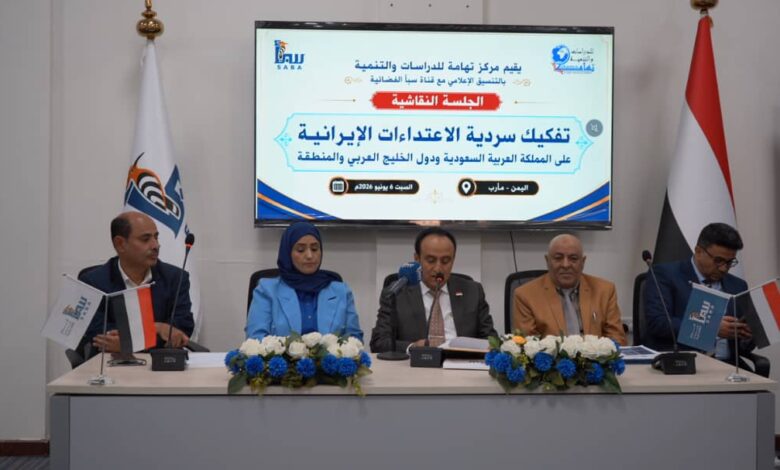
The session, held on Saturday in Marib, was organized by the Tihama Center for Studies and Development in partnership with Saba TV under the title “Deconstructing the Narrative of Iranian Attacks on Saudi Arabia, the Gulf Arab States, and the Region.” The event brought together a group of researchers, academics, and experts.
Participants recommended strengthening coordination and integration among research institutions, media organizations, and decision-making centers, while supporting efforts aimed at addressing threats to the security and stability of the region.
They also stressed the need to intensify specialized studies and research analyzing Iranian policies and their impact on regional security, alongside promoting public and media awareness of the risks posed by cross-border projects that affect state sovereignty and threaten security and stability.
During the opening session, Abdullah Abu Al-Ghaith, Deputy Speaker of the Shura Council, underscored the importance of combining research and academic efforts to reveal the nature, objectives, and effects of the Iranian project on the security and stability of regional countries. He said this would enhance societies’ ability to confront current challenges and understand their various dimensions.
For his part, Khaled Alyan, head of the Saba TV sector, affirmed the organization’s commitment to building effective partnerships with research centers and academic institutions in order to produce credible media and knowledge-based content that keeps pace with rapidly evolving political and strategic developments.
He explained that such partnerships are an important source of support for strengthening the role of national media in addressing issues related to Arab and Gulf national security, and in presenting them to the public in a professional and responsible manner based on facts and scientific studies.
The session featured a number of presentations and extensive discussions by researchers, academics, and media professionals. These addressed various topics covered in the working papers, particularly Iranian policies in the region and mechanisms for developing a media and knowledge-based discourse that contributes to addressing regional challenges and promoting stability.