Yemen Monitor / Special Monitoring:
The prisoner exchange agreement between the Yemeni government and the Houthi group sparked a wave of widespread international and regional welcome, being considered the largest humanitarian progress in the prisoner file since the beginning of the war, given the hopes it carries to end the suffering of thousands of Yemeni families and open a new window for confidence-building between the parties.
In the first international reactions, the United Kingdom welcomed the agreement, considering it a positive and tangible step that would alleviate the suffering of thousands of Yemeni families who have waited years for the return of their loved ones. London praised the efforts of the United Nations, the International Committee of the Red Cross, and the Kingdom of Saudi Arabia, and also expressed its appreciation for the role played by Jordan and the Sultanate of Oman in supporting the negotiations.
The British government called on all parties to commit to the full and timely implementation of the terms of the agreement, demanding the immediate release of all those arbitrarily detained by the Houthis, including humanitarian workers, stressing that the continued detention of aid workers hinders the delivery of life-saving aid to millions of Yemenis.
In the same context, the official spokesman for the Coalition to Support Legitimacy in Yemen, Turki Al-Maliki, announced the signing of an agreement that includes the release of 1,750 prisoners and detainees from various parties, including 27 from the coalition forces, among whom are seven Saudi prisoners.
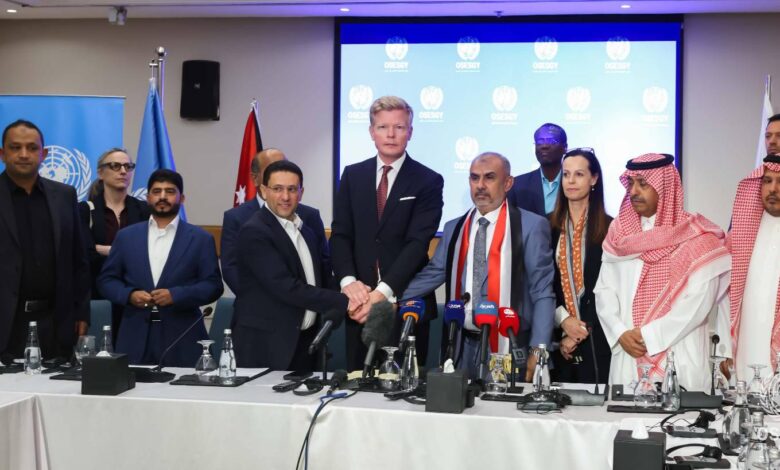
Al-Maliki explained that the agreement was signed in Amman in the presence of the negotiation committee of the Joint Forces, and under the auspices of the Office of the UN Envoy to Yemen, Hans Grundberg, stressing that the prisoner file receives direct attention from the coalition leadership until the release of all detainees is completed.
For its part, the Kingdom of Saudi Arabia welcomed the detainee exchange agreement, considering it a positive development that contributes to alleviating humanitarian suffering and enhancing chances for security and stability.
The Saudi Ministry of Foreign Affairs said that the agreement enhances trust between the parties and supports calm-building efforts in Yemen, praising Jordan’s efforts in hosting the rounds of negotiations, alongside the role of the United Nations and the International Committee of the Red Cross in facilitating the consultations.
The Kingdom also renewed its support for all efforts aimed at achieving peace and stability in Yemen in a way that meets the aspirations of the Yemeni people.
In turn, the United Nations welcomed what it described as a “major breakthrough” in efforts to release conflict-related detainees, considering the deal the largest since the outbreak of the war. The Deputy Spokesman for the United Nations, Farhan Haq, said that the agreement was the result of intensive negotiations held under UN auspices in Jordan, stressing the continued demands for the release of all those arbitrarily detained, including UN staff, NGOs, civil society organizations, and diplomatic missions personnel detained by the Houthis.
In the UN statement, the Special Envoy for Yemen, Hans Grundberg, announced that the parties had reached an agreement to release more than 1,600 conflict-related detainees. He considered this number unprecedented in the history of the current conflict in Yemen, noting that it comes as the fruit of 14 weeks of intensive negotiations held under the auspices of the United Nations in Amman, Jordan.
Grundberg said: “This is a moment of great relief for thousands of Yemenis whose painful wait for the return of their loved ones has been long. The relentless struggle and courage of the detainees’ families played an essential role in reaching this moment.”