Yemen Monitor / Marib / Agencies:
As freedom of navigation erodes across the Middle East, intelligence warnings indicate Houthi plans to formalize their control over Red Sea shipping, including the potential imposition of transit tolls. This move mimics recent Iranian precedents and threatens a region already reeling from successive crises.
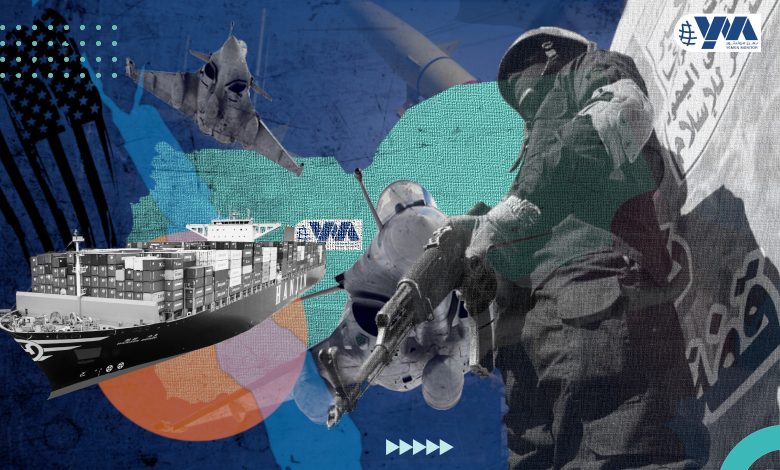
The British maritime security firm Ambrey revealed that the Houthi group has discussed mechanisms for imposing fees on vessels passing through the Red Sea. According to the report—cited by Lloyd’s List Intelligence, which specializes in shipping and maritime news—these discussions took place at high leadership levels, indicating a Houthi ambition that goes beyond merely disrupting navigation to exercising actual, organized control over strategic waterways.
Ambrey explained that these moves reflect the group’s desire to transform its military influence in the Bab el-Mandeb Strait into a permanent geopolitical and economic tool, presenting international shipping with a new reality characterized by financial extortion in exchange for safe passage.
“Yemen Monitor” had revealed in a previous report that the Houthis were already considering imposing fees at the Bab el-Mandeb Strait, even before the onset of the American-Israeli conflict with Iran, which led to the closure of the Strait of Hormuz and Iran’s imposition of transit tolls there.
The report noted that these talks received Iranian support and involvement, as Tehran seeks to transfer its experience in the Strait of Hormuz to the Red Sea. However, information confirms that the Houthis are looking to operate on their own terms, benefiting from Iranian expertise while maintaining independent decision-making in managing these maritime “levies.”
This development comes at a time when Iran is already enforcing a “toll collection point” system in the Strait of Hormuz, where ships are required to provide full documentation and obtain clearance codes, with fees that can reach exorbitant amounts—often paid in stablecoins or Chinese Yuan to evade international sanctions.
Ambrey warned that the Houthis’ possession of increasingly sophisticated weaponry makes it difficult for traditional military interventions to curb further escalation in the region. It noted that the group might adopt a multi-front approach to extend its control, complicating the missions of international alliances seeking to protect navigation.
The United Nations Convention on the Law of the Sea (UNCLOS) affirms the rules governing straits used for international navigation, where there is no legal justification or international agreement allowing the imposition of transit fees in these corridors. However, experts believe that the pace at which international rules are being rewritten by regional actors makes the “absence of legal precedent” an obstacle that can be bypassed, especially within a global system facing increasing challenges.