Yemen Monitor / Jerusalem /Agencies:
The Israeli Public Broadcasting Corporation revealed behind-the-scenes details of the Israeli strike that targeted a secret meeting of the Houthi government last Thursday.
The strike killed the Houthis’ Prime Minister Ahmed Al-Rahwi along with 10 other ministers and officials of the unrecognized government in Israeli air raids on August 28.
According to the report in Hebrew—translated by Yemen Monitor—this was the most powerful blow Israel had dealt to the Houthis since they joined the war against Israel at the outbreak of the Gaza war in October 2023. Despite a series of assassinations, Yemenis still managed to launch four ballistic missiles—two of them just last night (Tuesday)—all of which fell en route to Israel.
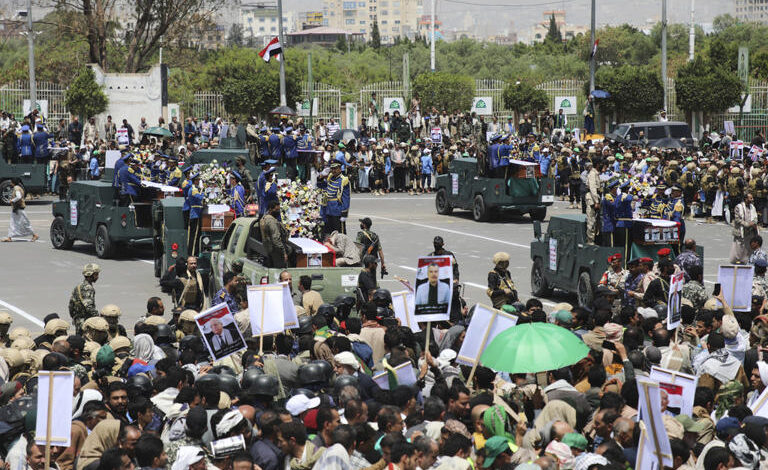
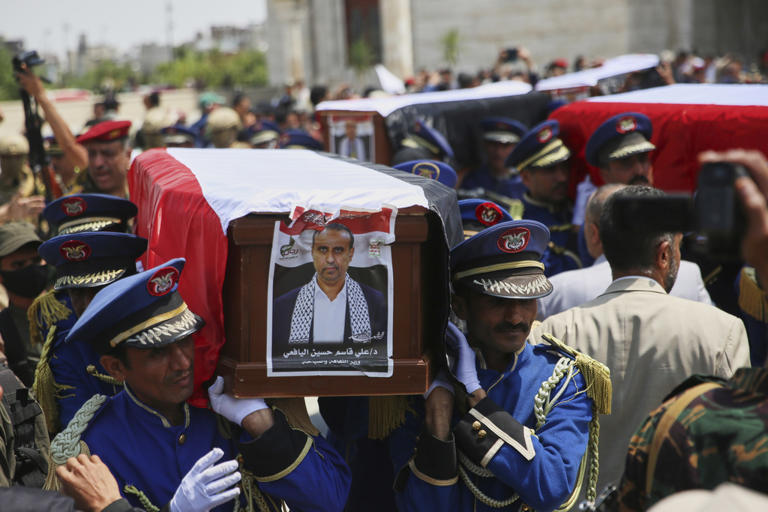
The report added: the day after the funeral of senior Houthi government officials in Sana’a, Israeli security officials told “KAN” News that Defense Minister Mohammed Al-Atefi and Chief of Staff Mohammed Abdulkarim Al-Ghumari were definitely in the villa that was attacked in the heart of the capital, and that claims coming from Yemen that the two—who are directly responsible for the military confrontation with Israel—survived should be treated with caution.
According to the broadcaster, Israel believes “the Houthis appear to be concealing losses among their top security leadership and are disoriented by the strike that hit their senior ranks. Israel makes it clear that Houthi leader Abdul Malik Al-Houthi is a target for assassination because of his importance to the Houthi regime.”
The report noted that in early July, as the Gaza fighting entered a new phase, Israel debated whether to pursue a deal or expand the war. At that time, Chief of Staff Zamir and Military Intelligence chief Bender tasked the “AMAN” Research Division with forming a new unit to focus on the Yemeni front.
It added: the decision stemmed from a clear understanding of the need to escalate Israel’s operations in response to missile and drone launches from Yemen. Around 200 soldiers and officers from different Israeli intelligence units (8200, 9900, 504) gathered in a secret bunker in central Israel and began collecting precise intelligence on the Houthis. The unit also included representatives from U.S. Central Command.
The broadcaster detailed the attacks, saying: prior to the Yemen strike, AMAN’s Research Division learned that senior Houthi government officials were preparing to convene a high-level security meeting, similar to a cabinet session, that would bring together top military commanders. Lieutenant Colonel “A” from AMAN’s Research Division, who concluded her assignment this week, immediately contacted Brigadier General “M,” head of operations at Aman, to inform him that the important meeting in Sana’a was about to convene and that all top government and military leaders were preparing to attend.
It continued: during the discussions, AMAN had some hesitation about the exact meeting point of the senior officials in Sana’a, so several options were drawn up and gradually narrowed down. Once the location became clear, and after swift approval of the plans from the Chief of Staff and a “green light” from the political leadership, the operation was launched using Air Force fighter jets. According to estimates, more than 20 senior Houthi officials were inside the building that was hit, along with drivers, guards, and attendants who accompanied them.
Security officials said the fact that the Houthis met in a villa—essentially a large apartment in a residential neighborhood—rather than in an official government building, was proof they were trying to conceal the meeting and had chosen the most secretive location they could find. The presence of ministers, the prime minister, and top military leaders—the defense minister and the chief of staff—together in one place made the strike possible.
The report, citing Israeli security officials, concluded: “The stature of Houthi leader Abdul Malik Al-Houthi has made him a target for assassination not only for Israel but also across Western intelligence communities. This is why Al-Houthi has lived in secrecy for years, his speeches are pre-recorded, and his conduct resembles that of Nasrallah in his later years. The evidence is that in every country that previously fought the Houthis in Yemen, he was described as carrying enormous symbolic weight, and his assassination would shake the Yemeni organization.”