Yemen Monitor/Special Report:
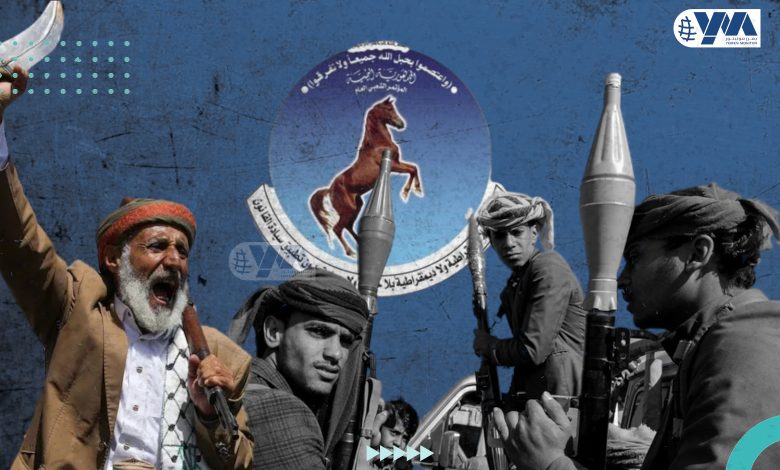
In recent days, tensions have noticeably escalated between the armed Houthi group and the General People’s Congress (GPC) party. This is occurring within a context of rapid political developments that suggest a potential reshaping of Yemen’s political map. Simultaneously, the internationally and regionally backed legitimate government is making calculated moves, showing clear signs of readiness for a new round of confrontation. This is supported by increasing regional momentum and based on internal reforms, most notably a marked improvement in the economic situation and the recovery of the national currency in Aden and areas controlled by the legitimate government.
At the heart of these moves are persistent attempts to unify republican forces, primarily the GPC and the Islah Party, into a single political front. This front could form the core of a national project capable of restoring the state and changing the current power dynamics. Despite the historical disagreements and tensions between the two parties, current indicators suggest that a strategic alliance between them—based on clear, shared goals—could succeed in bringing about a real shift in the balance of power. This is especially true if they leverage their popular bases and political and administrative expertise in a battle described as “pivotal” for Yemen’s future.
A Preemptive Move to Undermine Unity
The Houthis, fully aware of the risks posed by these shifts, view them as a direct threat to their political and military agenda. This has prompted them to escalate preemptively—through repression of any internal movements in Sana’a, as seen in recent actions against GPC leadership, and through the use of their judicial, media, and security arms to suppress any signs of political revival.
On Saturday evening, the Houthi group sparked a new political crisis in Sana’a when its gunmen stormed a meeting of the GPC’s Permanent Committee held at Al-Mithaq Institute. The meeting, chaired by Sadeq Amin Abu Ras—the party’s head in Houthi-controlled areas—was intended to prepare for the party’s anniversary. However, according to a source speaking to Yemen Monitor, the Houthis saw the gathering as an unacceptable breach of their authority, forced attendees to leave, and warned against holding similar meetings without their prior approval.
This incident was not an isolated one but part of a broader Houthi campaign to dismantle what little independence the GPC still has in Sana’a. Just two days earlier, a Houthi-run military court issued a death sentence in absentia against Ahmed Ali Abdullah Saleh—the son of Yemen’s late president and the GPC’s vice president. The move, widely seen as a politically motivated message both domestically and internationally, signaled that the Houthis would not tolerate any effort to revive the GPC or unify republican forces under its umbrella.
Widening Discontent and Signs of Political Shift
In the context of this escalation, Yemeni journalist Musaab Afif believes that what happened at the Mithaq Institute in Sanaa cannot be read as an isolated incident. Instead, it is a “preemptive escalation by the Houthis, who feel increasing political pressure from both inside and outside the country. They fear moves that could lead to the reunification of the GPC as a political bloc capable of competing with them and perhaps tipping the balance of power in northern Yemen.”
Afif added in an exclusive statement to “Yemen Monitor” that “Sanaa is experiencing a state of political discontent, not only among GPC members but even among some social groups that were once associated with the Houthi group. This is a result of deteriorating living conditions and worsening political oppression. This discontent reflects a suppressed desire for change and makes any unified republican political movement a real source of concern for the group.”
In an explicit call to the remaining GPC leaders in Sanaa, Afif urged them to “evaluate the phase of a nominal partnership with the Houthi militia, which has ended in exclusion, marginalization, oppression, and abuse. The group used them as a scapegoat for its failures, corruption, and tyranny, and to legitimize the atrocities it has committed against Yemenis over the past years.”
He added that “the time has come to unite national and international efforts to end the bitter story of the Houthis and put a stop to the continuous violations against GPC leaders, cadres, and all Yemenis striving for a just, civil state.”
Afif’s statements reflect a growing sentiment among a segment of the political elite that the balance of power may be subject to change if the current political moment is intelligently leveraged. This includes rebuilding a broad political alliance between the GPC, Islah, and other republican forces, supported by economic reforms and supportive regional action. This could serve as a prelude to shaking the foundations of Houthi rule in its historical strongholds.
Turning Point: Will the Last Opportunity Succeed?
On the other side of the political spectrum, sources indicate that effective efforts are underway within the internationally recognized government to restructure the republican forces and move beyond the fragmentation that has weakened their position in recent years. Central to these efforts is the attempt to unify these forces under the umbrella of the General People’s Congress (GPC)—not only as a historic party but as a political vessel capable of rallying divergent currents under the banner of the “Republic” in opposition to the Houthi project, which is marked by sectarian and dynastic undertones.
According to these sources, a figure from the family of the late President Ali Abdullah Saleh could serve as a long-awaited focal point—given the family’s political symbolism in Yemen’s power dynamics and the GPC’s broad grassroots base and its capacity to communicate through a unifying national discourse.
In this context, the recent appearance of Madin Ali Abdullah Saleh, nephew of the late president, on the television program “The Final Battle” marked a significant turning point. Though his appearance may have initially seemed media-oriented, its deeper implications become clearer when viewed within the current political moment. According to political analyst Hilal Al-Muntasir, the appearance “sent clear signals that quiet arrangements are underway to restore the GPC to political prominence—either from within the legitimate government camp or through active regional channels.”
Al-Muntasir explained to Yemen Monitor: “Saudi Arabia, which had a serious rift with the Saleh family’s wing after 2014, appears more open today to the idea of a future partnership with the GPC—particularly after other factions within the legitimate government failed to assert effective presence on the ground or present a compelling political model. This regional rapprochement with the GPC largely explains the Houthis’ panic over any signs of the party’s revival.”
The GPC’s Last Chance?
While the GPC still suffers from deep internal divisions—with rival factions spread across Sana’a, Aden, Cairo, and Abu Dhabi—the current political climate may offer a rare historic window for reunification and repositioning as a republican force capable of playing a central role in shaping Yemen’s future, according to political observers.
These observers note that regional shifts, along with international willingness to reassess political tools in Yemen, and the failure of other legitimacy-aligned parties to present a viable administrative or political model—all place the GPC in a position to potentially lead a national bloc that could restore some balance to Yemen’s deeply skewed post-2014 political landscape.
Still, this path is anything but easy. According to informed political sources, the internal rifts remain profound, and distrust between GPC leaders inside and outside Yemen runs deep. Moreover, the Houthis are expected to deploy every available means of repression to crush any sign of the GPC reemerging as an independent political force, particularly within territories under their control.
Sources also stressed that producing a political leadership with both popular credibility and regional/international acceptance is no simple feat—it requires a methodical political approach, a willingness to make painful compromises, and major sacrifices in pursuit of a unified national project.
Nonetheless, the Houthis’ mounting anxiety over any republican rapprochement, as described by political analyst Hilal Al-Muntasir in comments to Yemen Monitor, reflects the magnitude of the threat the GPC could pose—if it is strategically reengineered. Al-Muntasir noted, “The group will continue its policies of repression and intimidation, but may ultimately fail to contain the ongoing shift on the ground—especially if internal dynamics align with regional transformations and the GPC evolves from a historical burden into a national opportunity.”
Overall, observers warn that if the GPC and the Islah Party fail to unite under a clear political front, Yemen’s political landscape could slide into a new phase of stagnation—allowing the Houthis to further entrench their project as an irreversible reality. This makes the current moment possibly the final window of opportunity to truly shift the balance of power.