Rights Seminar in Marib Calls for International Trial of Sheikh Hantous’ Killers

Yemen Monitor / Marib:
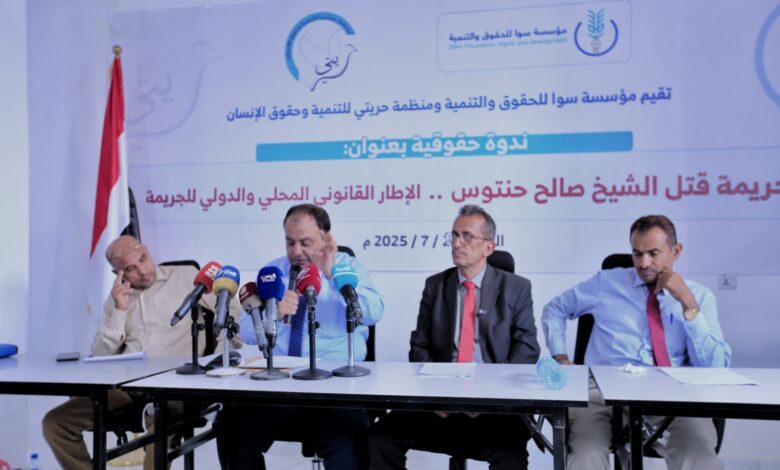
A human rights seminar held in the city of Marib on Saturday called for urgent international action to prosecute those responsible for the assassination of Sheikh Saleh Hantous and to pursue Houthi leaders implicated in what has been described as an “extrajudicial killing” and a grave violation of both domestic and international laws.
Participants in the seminar—organized by the Sawa Foundation for Rights and Development in partnership with Hurriyati Organization for Development and Human Rights—stressed that holding the perpetrators accountable is not only a legal demand but also a national and moral responsibility. Silence, they warned, only encourages impunity and deepens ongoing violations against Yemenis.
Titled “The Killing of Sheikh Saleh Hantous: The Legal Framework under Domestic and International Law”, the seminar called for the involvement of the UN Special Rapporteur on extrajudicial executions, and the launch of an independent international investigation into the crime. It also urged international human rights bodies—such as the UN Human Rights Council, Amnesty International, and Human Rights Watch—to take up the case.
Key recommendations included designating the Houthi group as a terrorist organization, and urging the International Committee of the Red Cross (ICRC) to intervene for the release and protection of Sheikh Hantous’ detained family members.
In his opening remarks, Khaled Al-Raimi, head of Hurriyati, described the killing of Sheikh Hantous as a “summary execution” carried out in a brutal, unlawful manner. He emphasized that an excessive use of armed force was used against an unarmed civilian, in violation of the right to life, dignity, and security.
The seminar featured three legal and analytical papers:
- Dr. Omar Kazaba, Professor of Criminal Law at the University of Saba Region, examined the crime under Yemeni constitutional law. He asserted it constitutes “premeditated murder with full criminal elements,” committed using methods contrary to tribal and humanitarian norms, necessitating immediate judicial action.
- Dr. Ammar Al-Bakheiti, Professor of International Law, addressed the case under international humanitarian law, classifying it as “extrajudicial execution” and arguing that it qualifies for prosecution under the principle of universal jurisdiction should local justice fail.
- Researcher Abdel Khaleq Al-Atshan focused on the systematic nature of the killing, viewing it as part of a deliberate Houthi policy to silence opponents, fitting the legal definition of “crimes against humanity.”
In closing, the seminar emphasized that justice in the case of Sheikh Saleh Hantous is a critical test of the international community’s seriousness in confronting political crimes and systematic violations in Yemen.