Yemen Monitor / Special Monitoring:
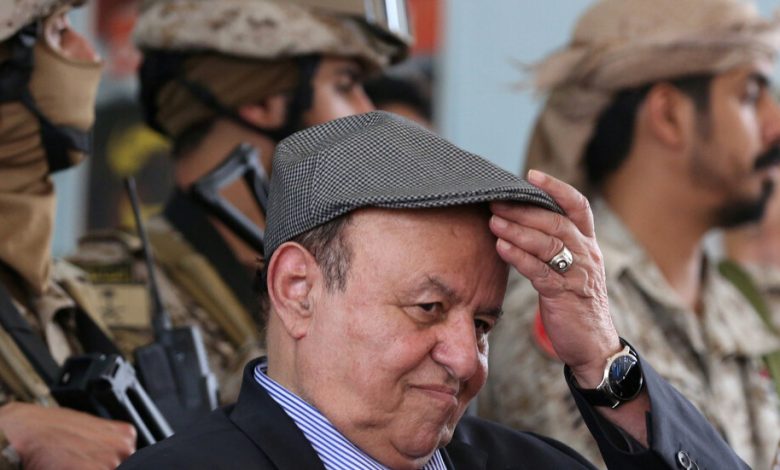
Former Yemeni President Abdrabbuh Mansur Hadi passed away in his residence in the Saudi capital, Riyadh, early Thursday morning, following a deterioration in his health. His passing concludes a political era intertwined with one of the most complex and turbulent periods in the modern history of Yemen.
According to government sources and others close to his family, Hadi suffered a health crisis over the past few days while at home, before being hospitalized multiple times. He had remained under medical care at a hospital in Riyadh for the last two weeks.
The former president had been absent from the political scene since April 2022, following his announcement transferring his full powers to the Presidential Leadership Council headed by Rashad al-Alimi—a step that ended a decade of his presidency held under exceptional political and security conditions.
Abdrabbuh Mansur Hadi is the second president of the Republic of Yemen since unification and served as the Supreme Commander of the Armed Forces starting in 2012. He is viewed as one of the most prominent figures who managed the country during its transitional phase and the accompanying political shifts, security upheavals, and wide-scale war.
Hadi was born on September 1, 1945, in the village of Dhakin, located in the Mudiyah district of the Abyan Governorate in southern Yemen. He received his military education at the Aden Protectorate Army School, which was dedicated to training the sons of the Federal Army officers of South Arabia, graduating in 1964.
During the pre-unification years, he climbed through several military ranks in the South Yemen army, holding various leadership positions. In 1983, he was promoted to Deputy Chief of Staff for Supply and Administration, and he also chaired the negotiation committee for arms deals with the Soviet Union.
Following the bloody January 1986 events in South Yemen, Hadi moved to Sana’a, beginning a new phase of political and military involvement in the North. Following the declaration of Yemeni unification in 1990, he took command of the Al-Bayda military axis.
In May 1994, a decree was issued appointing him Minister of Defense. Later that year, on October 3, he was appointed Vice President of the Republic, a position he retained until 2012.
On February 21, 2012, Hadi won the presidential election held in accordance with the Gulf Initiative. He took the constitutional oath on February 25, before officially assuming the duties of the presidency on February 27, 2012, amidst escalating political and security challenges.
During his rule, Yemen witnessed major transformations, most notably the Houthi group’s takeover of the capital, Sana’a, and the outbreak of the war that forced the government to leave the capital, plunging the country into a complex phase of conflict and division.
On April 7, 2022, Hadi announced the formation of a Presidential Leadership Council to complete the tasks of the transitional period, delegating his full powers to the council, which ended a political phase that lasted nearly ten years at the helm of power.