Between the Energy War and Lack of Responsibility: Yemen Faces a Global Crisis Without Preparation
By/Mareb Al-Ward

Yemen Monitor/ Special Writings:
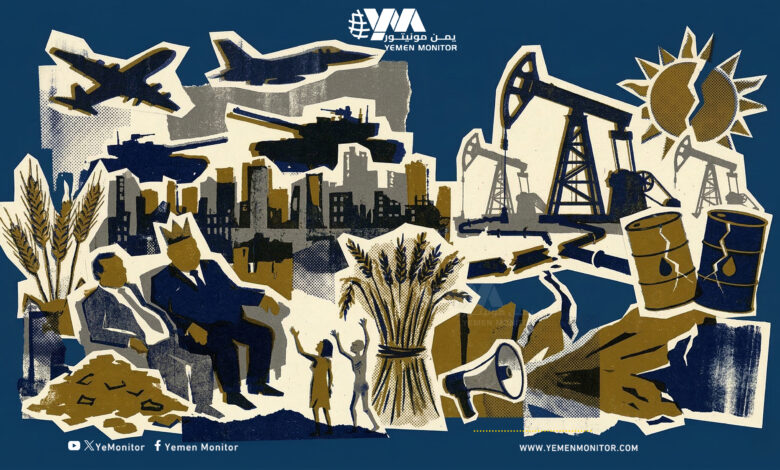
The ongoing war between the United States and Israel on one side and Iran on the other has disrupted navigation in the vital Strait of Hormuz and halted oil and gas production in Gulf countries, causing energy prices to rise to record levels. This has pushed many countries to adopt austerity measures to cope with a crisis whose trajectory remains uncertain.
Although some major countries with strategic oil reserves are considering releasing large quantities into the market to lower prices—due to the economic and social repercussions of rising energy costs and their potential political consequences, especially with the approaching U.S. midterm elections, which Republicans fear—the continuation of the war and the absence of any signs of a diplomatic solution are worsening the crisis on multiple levels.
In Yemen, however—where the country relies almost entirely on imports to secure food and fuel—there appear to be no real preparations or measures to deal with the crisis and its consequences. Neither the internationally recognized government nor the Houthi group, which controls most of the country’s population centers, has shown any meaningful sense of responsibility toward the public.
From the beginning of the war, the government’s response has largely been limited to meetings whose outcomes amounted only to directives to secure strategic wheat reserves, the staple food for most Yemenis. Yet officials’ statements have been contradictory: the Minister of Industry and Trade said the reserves would last three months, while the Chairman of the Presidential Leadership Council stated they could last four to six months. The lack of agreement on such vital information reflects the absence of a clear plan for dealing with the crisis.
If officials themselves do not possess accurate information about wheat reserves, it raises serious doubts about the country’s readiness to face these challenges—especially in a nation where most people have lived under poverty and hunger for years.
The Houthis, meanwhile, appear no more concerned about the crisis. Like the government, they have not managed the country’s resources with transparency or fairness. Instead, they remain focused on military events and preparations related to the possibility of joining the war alongside Iran, leaving citizens to face escalating economic hardships on their own.
Both sides, it can be said, are treating the livelihoods of citizens with indifference. The Yemeni people, exhausted by all political factions, have experienced various governing forces over the past years—yet the common outcome has been failure, corruption, favoritism, and the division of state resources, in the absence of any form of accountability. Moreover, these groups did not come to power through the will of the people or elections.
Looking at how other countries are responding to the same crisis reveals a stark contrast. South Korea, one of the world’s largest economies, has begun studying measures related to fuel management and support for companies and small businesses to mitigate economic repercussions.
In China, where average incomes are higher, the capacity to absorb economic shocks appears stronger. Meanwhile, Pakistan, which has long struggled with economic difficulties, has implemented strict austerity measures—including salary cuts for officials and ministers, reductions in public spending, and the suspension of many government vehicles—even though corruption still exists there. Despite this, the government recognizes that failing to act quickly could lead to consequences beyond its control.
In Yemen, however, the situation is entirely different. Although conditions demand swift and strict action, the Houthis rely primarily on force to suppress any potential public anger. On the other hand, the government—supposedly representing legitimacy—has not shown even minimal responsibility. It should have announced strict austerity measures given its limited resources and heavy dependence on external support, particularly Saudi financial assistance, to cover expenses such as public-sector salaries.
Since the formation of the government, ministers—including the prime minister—have been preoccupied with meetings with NGO staff and media figures as part of personal publicity campaigns and competition over creating ministry accounts on social media platforms. The Minister of Information and his deputies and advisors have even spent days celebrating the creation of a ministry account on Twitter (X) for the first time, after it had effectively been monopolized through the minister’s personal account—despite the fact that he reportedly told ministry employees there was no need to activate institutional accounts as long as his own account receives 30 million monthly views.
More than a month after the government’s formation, many citizens still struggle to receive their salaries. The government has also failed to pay some military units and has not addressed the ongoing cash liquidity crisis.
When the Central Bank recently introduced a 100-Yemeni-rial banknote, traders and money exchangers refused to accept it. Neither the bank nor the government has taken steps to solve the problem, leaving citizens—especially public employees who received their salaries in this denomination—unable to purchase necessities or use their money normally.
Those who rely on remittances from relatives working abroad, particularly in Gulf countries, face even greater difficulties. Exchange shops have begun refusing to exchange more than 500 Saudi riyals, amid attempts to create disruptions in the currency market.
Given the seriousness of the current circumstances, the government and the Presidential Leadership Council should adopt real austerity measures to demonstrate credibility and restore some public trust. Possible steps include:
First: The Presidential Leadership Council should announce a temporary 50% reduction in the salaries and financial allocations of its members during the crisis period. According to available information, the head of the council receives about 2 billion Yemeni riyals monthly, while each member receives around 650 million riyals, meaning the total monthly salaries could reach about 7 billion riyals. If the crisis lasts, say, two months, this amount could be redirected to support social welfare programs for families with no source of income.
Second: The Prime Minister and ministers should announce a 50% reduction in their salaries—a measure that would not actually affect their standard of living given the size of the allocations they receive.
Third: Halt any new appointments in the state’s administrative apparatus, which already suffers from bloat and inflation due to appointments based on patronage rather than actual need.
Fourth: Suspend all unnecessary foreign travel for ministers and officials for any events or tasks, including participation by the Prime Minister himself, and rely solely on ambassadors abroad to represent the country. It was particularly odd that a minister traveled to a European country to lecture on peace while neighboring countries, including those funding his government, were preparing economic measures in line with developments.
Fifth: Stop the subsistence allowance lists that cost the state treasury about $11 million monthly, according to Mohammed Halboub, Chairman of the state-owned National Bank’s Board of Directors, especially since most beneficiaries live abroad, have settled in other countries, arranged their affairs, and have investments.
Sixth: Reactivate support programs for poor families and support the Yemeni Economic Corporation so that citizens can purchase food items at reduced prices, in addition to activating an interest-free deferred payment system.
Such steps require only genuine political will and a sense of responsibility towards citizens. Despite doubts about their feasibility, they remain possible and necessary measures to confront the current crisis.
Such steps require nothing more than genuine political will and a sense of responsibility toward citizens. Although there may be doubts about whether these measures will actually be implemented, they remain both possible and necessary to confront the current crisis.