Houthis Threaten to “Paralyze” Saudi Airports and the Bab al-Mandab to Secure Tehran–Sanaa Air Corridor


Yemen Monitor / Sanaa / Special Report:
The Houthi group has vowed to continue operating direct flights between Sanaa and the Iranian capital, Tehran, under any circumstances, declaring its full readiness to “paralyze Saudi airports” to ensure the continuation of the air route. The statement marks a significant public escalation that threatens to undermine years of de-escalation efforts and could push Yemen back toward a broader conflict.
Mohammed Al-Bukhaiti, a member of the group’s Political Bureau, said that direct flights between Sanaa and Tehran constitute a “red line” that the Houthis will not abandon, regardless of the military cost.
In press statements, Al-Bukhaiti argued that any attempt to prevent flights to and from Sanaa International Airport would effectively end the truce and give the Houthis what he described as the full right to target Saudi airports and impose a “similar air blockade” on the Kingdom.
As tensions continue to rise, Al-Bukhaiti also warned that the option of closing the Bab al-Mandab Strait—a vital global maritime trade route—remains on the table as a strategic pressure tool against countries participating in what he called the “aggression against Yemen.” He claimed the group has the capability to use this option to protect its interests.
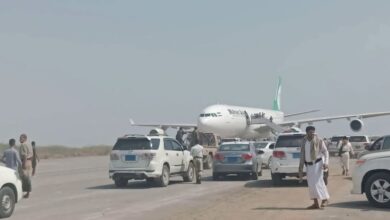
The threats came shortly after the runway at Sanaa International Airport was struck on Monday as an Iranian aircraft carrying a Houthi delegation—including Al-Bukhaiti himself—approached the airport after returning from Tehran. According to the report, the delegation had attended the funeral of Iran’s late Supreme Leader. Field sources said the aircraft was forced to divert and land at Hudaidah Airport, located in the Houthi-controlled coastal governorate.
In what the report described as a swift operational response to the runway strike, the Houthis launched a volley of ballistic missiles toward Abha International Airport in southern Saudi Arabia. The Saudi-led coalition later announced that its air defenses had successfully intercepted and destroyed the missiles.
On Monday, Rashad Al-Alimi, Chairman of Yemeni Presidential Leadership Council, stated that his government would not permit any Iranian aircraft to enter Yemeni airspace. The internationally recognized Yemeni government claimed responsibility for the measures taken at Sanaa Airport, describing them as a sovereign action intended to prevent an aircraft linked to Iran’s Islamic Revolutionary Guard Corps (IRGC) from landing.
During an emergency session of the UN Security Council, Yemeni Ambassador to the United Nations, Abdullah Al-Saadi, said the Iranian aircraft was using humanitarian flights as cover to transport “personnel, experts, and dual-use military equipment.” He added that the Yemeni government had previously offered to facilitate the Houthi delegation’s return aboard official Yemenia Airways flights, but the group chose to travel on the direct Iranian flight for political and military reasons.
The report also noted that the Houthis have previously carried out a series of attacks against commercial vessels in the Red Sea, claiming they were acting in solidarity with the Gaza Strip.