President Al-Alimi Urges Consultation and Reconciliation Commission to Fulfill Its Role in Supporting State Institutions

Yemen Monitor / Newsroom:
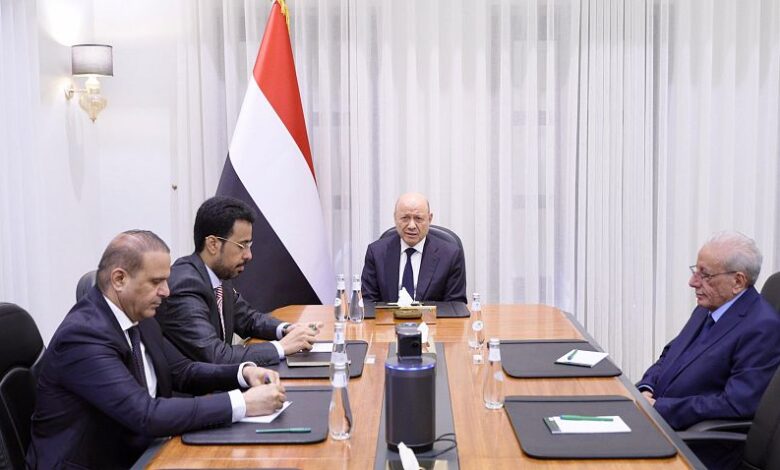
Chairman of Yemeni Presidential Leadership Council, Rashad Al-Alimi, met on Monday with the leadership of the Consultation and Reconciliation Commission to discuss the latest national developments and the commission’s plans to support the Presidential Leadership Council in the coming period.
According to the official Saba News Agency, the meeting included Commission Chairman Mohammed Al-Ghaithi and his deputies—Abdulmalik Al-Mikhlafi, Sakhr Al-Wajeeh, Jamila Ali Raja, and Akram Al-Amiri. The participants reviewed the commission’s work programs aimed at strengthening national consensus.
Al-Alimi stressed the importance of the commission fulfilling the responsibilities assigned to it under the Declaration on the Transfer of Power, particularly promoting unity among Yemen’s various political and national components in support of state institutions and the completion of the transitional phase.
The Presidential Leadership Council chairman also briefed the commission on the latest political, security, and military developments, condemning what he described as the Houthi group’s escalation and Iran’s repeated violations of international resolutions.
Al-Alimi warned of what he called a “blatant violation of Yemeni sovereignty,” referring to a recent flight that he alleged transported military experts and military-related technology to Houthi-controlled areas. He argued that the incident directly undermined de-escalation efforts in Yemen and the wider region and challenged the will of the international community.
He also praised what he described as the “qualitative successes” of Yemen’s security and intelligence services in identifying and dismantling alleged terrorist cells and networks and thwarting their plans, saying these achievements reflected the growing capabilities of state institutions.
Al-Alimi concluded by emphasizing that the current stage requires the highest level of coordination and integration among state institutions and their supporting bodies, stronger unity in national decision-making, and the mobilization of resources to restore state institutions and protect Yemen’s economic gains.