Yemen Monitor / Newsroom:
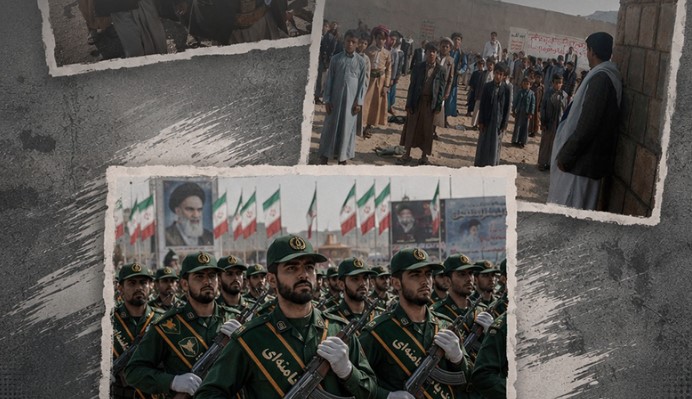
A policy assessment issued by the Mokha Center for Studies has warned that the Houthi group’s general mobilization forces have evolved beyond a temporary wartime tool into a strategic project aimed at establishing an ideological and military apparatus parallel to official state institutions. According to the report, the model is inspired by Iran’s Basij force and is intended to further militarize Yemeni society while providing the group with a sustainable mechanism for recruitment, control, and combat mobilization.
The assessment explained that the Houthis used the war in Gaza, which began in October 2023, as a political and ideological cover to expand recruitment and mobilization campaigns under the slogan (Toophan Al-Aqsa) “Al-Aqsa Flood.” These campaigns gradually evolved from symbolic demonstrations of solidarity into an organized effort to build a broad human network extending across the governorates, districts, and villages under the group’s control.
According to the report, by mid-2026 the Houthis announced that they had trained more than one million people as part of what they call the “General Mobilization Forces,” reflecting a shift from emergency wartime mobilization toward a permanent, institutionalized mobilization system.
The report argued that the project’s significance lies not only in its size but also in its organizational structure. It said the mobilization forces operate as a popular and ideological arm reporting directly to the group’s religious leadership and the office of Houthi leader Abdul-Malik al-Houthi, rather than through the conventional military chain of command.
It added that the system is managed through an extensive local network that grants mobilization officials in districts and local communities powers that, in some cases, exceed those of official administrative authorities. The network also maintains close coordination with security and intelligence agencies, enabling the group to strengthen its control over society from within.
The assessment viewed a statement issued by the Houthis on June 22, 2026, as marking a significant shift in the group’s rhetoric. Instead of focusing primarily on support for the Palestinian cause, the statement declared immediate readiness to reinforce domestic battlefronts. The report argued that this shift serves four main objectives:
- Raising the political cost of any peace settlement that does not accommodate Houthi interests.
- Preparing the ground for a limited military escalation.
- Applying political and economic pressure on Saudi Arabia.
- Tightening internal security control amid growing public dissatisfaction over deteriorating living conditions.
The report warned that if this approach continues, it is likely to expand the militarization of tribes, educational institutions, and local administrative bodies, further eroding civilian life in Houthi-controlled areas. It also cautioned that worsening economic conditions could increase the likelihood of forced or semi-forced recruitment, while tying Yemen more closely to Iran’s “Unity of Fronts” strategy and to military developments in the Red Sea and the wider region.
In its conclusion, the Mokha Center for Studies outlined three possible scenarios for the coming period. It assessed that the most likely scenario is a limited military escalation, involving tactical attacks around Marib, Hudaidah, or Taiz, aimed at maintaining a state of mobilization while strengthening the Houthis’ negotiating position.
The report also identified the continued pursuit of diplomatic containment—through the efforts of the UN Special Envoy and ongoing communication channels with Saudi Arabia—as another possibility. By contrast, it judged that a full-scale war remains the least likely scenario due to its high military and political costs, as well as the readiness of government forces to respond to any major escalation.