Alimi to European Delegation: Treating Houthis as a Political Party is a Structural Error that Prolongs War

Yemen Monitor / Newsroom:
The Head of the Yemeni Presidential Leadership Council, Rashad Al-Alimi, stated that any international approach treating the Houthi group as a natural political party represents a fundamental error that opens the door for continued conflict and the reproduction of violence in Yemen, warning that a “temporary peace” that bypasses the state will quickly collapse.
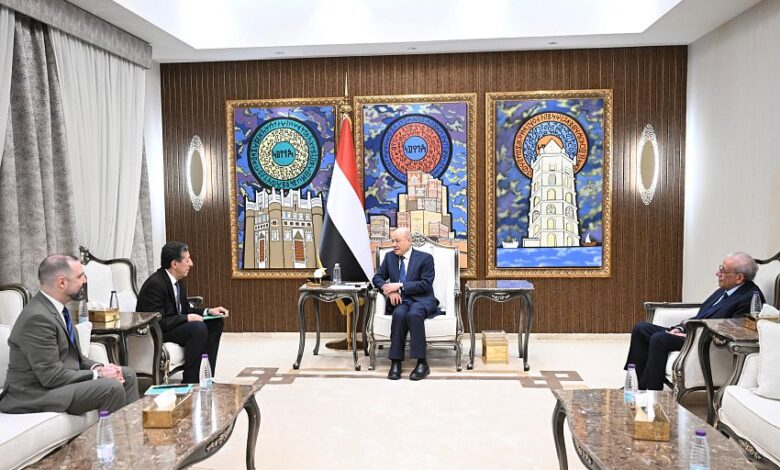
During his meeting with a delegation from the European Institute of Peace in Riyadh, Al-Alimi stressed that the peace sought by Yemenis cannot be achieved outside the framework of a single state and unified authority. He argued that post-war experiences in Europe prove that bypassing the state in settlement tracks leads only to fragile truces that soon turn into new rounds of conflict.
He pointed out that the Houthi group, according to his description, does not operate based on a traditional political project but rather from an ideological structure based on dynastic discrimination and the monopoly of power, which makes integrating them as a natural actor in the political process a structural danger to any future settlement.
Al-Alimi explained that the peace equation in Yemen must be based on dismantling ideological weaponry, ending the logic of dynasticism, and consolidating the principle of equal citizenship, alongside building a state capable of monopolizing the use of force and protecting all its citizens without discrimination.
The Head of the Leadership Council warned that any agreement that does not include implementation mechanisms and real guarantees will inevitably lead to a return of violence. He emphasized that what is required is the dismantling of the military and intellectual structure of armed groups, the criminalization of sectarianism and racism within constitutional and legal frameworks, and preventing the legitimization of realities imposed by force.
Al-Alimi asserted that Yemen needs to transition from managing the conflict to addressing its root causes, considering that peace is not made by balancing power between a state and a militia, but rather by empowering state institutions and drying up recurrent sources of violence.
Speaking on internal developments, he noted that the country is undergoing transformations aimed at restoring the state’s authority through the formation of a new government, unifying security and administrative decision-making, ending the duality of power, and improving services. He explained that these steps represent essential requirements for any sustainable peace.
The Head of the Leadership Council praised the role of the European Institute of Peace in supporting dialogue between various Yemeni components and contributing to discussions related to security, peacebuilding, and community issues, emphasizing the importance of this role in the current phase.