Yemen Monitor / London / Exclusive:
A report published by the British newspaper The Guardian has concluded that the Southern Transitional Council’s (STC) complete military control over the eight provinces of southern Yemen does not equate to it possessing independent political decision-making.
The newspaper confirmed that the future of the Council and its next steps toward declaring secession remain “wholly contingent” on the decisions and strategic calculations of its main backer, the United Arab Emirates (UAE), and not on the desires of local leaders in Aden.
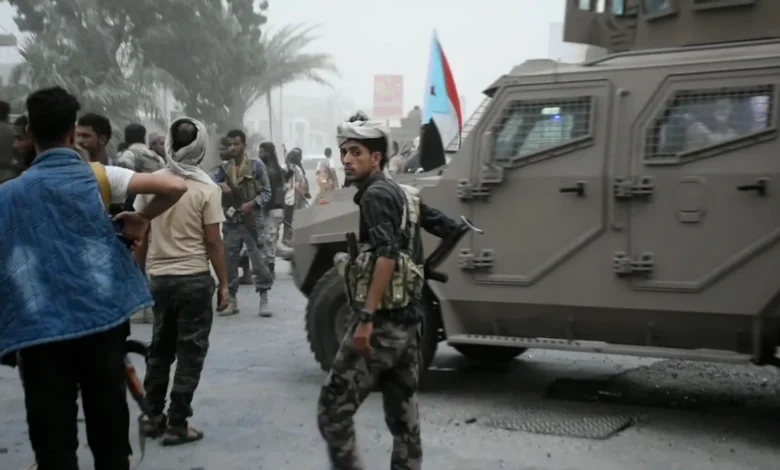
The report explained that despite the deployment of 10,000 STC soldiers to take control of Hadramawt and Al-Mahra, and its tightening grip over the entire southern geography for the first time, the “Council’s future will ultimately depend on decisions made by its primary patron: the UAE.”
The newspaper points out that Aidarous al-Zubaidi, who now controls the “Petromasila” company and the country’s economic resources, cannot take a politically risky step like declaring a “state” without full Emirati cover. It cites the experience of “Western Sahara,” which showed that the absence of strong international diplomatic support can turn secession into isolation—a reality Abu Dhabi is well aware of and holds the strings to.
The newspaper linked the STC’s extensive military movement to the UAE’s regional tensions, suggesting that Abu Dhabi is the one that gave al-Zubaidi the “green light” to move specifically at this time.
It framed this move within the context of an “angry reaction” from the UAE towards Saudi Arabia, due to Riyadh’s request for US President Donald Trump to intervene in the Sudanese war file (where the UAE faces accusations of supporting the Rapid Support Forces).
According to the analysis, the UAE is using the “STC” card in Yemen as a geopolitical pressure tool against Riyadh, confirming that the Council’s field movements are part of a broader Emirati strategy that extends beyond Yemen’s borders.
While Western diplomats have contacted al-Zubaidi to gauge his intentions, the newspaper confirmed that the Council might resort to proposing the idea of a “referendum” in the medium term as an interim solution, but the final outcome of this scenario will remain locked in Emirati drawers.
Since its establishment in 2017, the STC has fundamentally relied on Emirati funding, weaponry, and political cover. This dependence has created a complex equation; while the STC possesses power on the ground, Abu Dhabi holds the “on/off switch.”