Yemen Monitor / Newsroom:
An analytical paper issued by the Al-Mokha Center for Strategic Studies reveals that the UN Security Council’s decision to extend the mandate of the United Nations Mission to Support the Hudaidah Agreement (UNMHA) is not merely a routine procedural step. Instead, it reflects strategic shifts in the international community’s approach to the Yemeni file and entrenches a de facto reality that could evolve into a settlement marginalizing the internationally recognized government.
The paper asserts that the extension effectively freezes the battle for Hudaidah’s liberation, amidst undeclared regional and international understandings where the Yemeni issue intertwines with broader matters. These prominently include negotiations on Iran’s nuclear program and the rearrangement of international influence in the Red Sea.
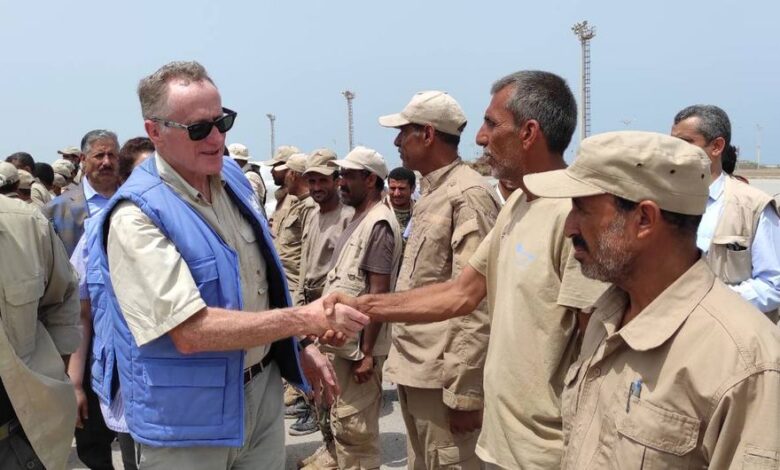
The paper criticizes UN performance, noting that the UNMHA mission has long lost its effectiveness. This occurred after the Houthi group established de facto control over its headquarters in Hudaidah city, with a complete absence of any real oversight over the implementation of the Stockholm Agreement. This has transformed the mission into a mere “formal facade” providing legal cover for the status quo.
The paper also tracked previous developments leading up to the UN resolution, including the Houthis’ halt of attacks in the Red Sea as part of an undeclared understanding with Washington. Additionally, Israeli airstrikes targeting Houthi sites in Hudaidah port were considered an indicator of tactical preparations for a potential confrontation, whether direct or by proxy.
The paper describes the current scene in Yemen as a “temporary de-escalation”, being used to redistribute influence. This comes amidst indications that the Houthis possess advanced military technologies and possibly radioactive materials, which are used as a pressure card in regional and international political and media discourse.
Al-Mokha Center criticized the Yemeni government’s inability to leverage these transformations, attributing it to what it described as “administrative paralysis and political division.” This has weakened its negotiating position and granted the Houthis a wider margin for maneuvering and expansion.
The paper warns that the continuation of this trajectory will lead to Hudaidah becoming a closed sphere of influence for the Houthis, within the context of an undeclared international settlement that excludes the legitimate government and keeps the conflict in a gray area. This carries strategic implications for the future of Yemen and the security of the Red Sea.