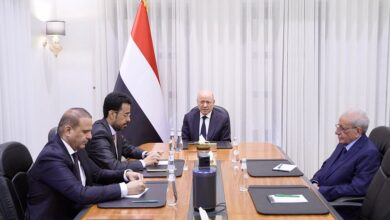
Al-Alimi to Envoy of Sponsor States: IRGC Flight to Sana’a is a Violation of Yemeni Sovereignty and a Defiance of Security Council Resolutions

Yemen Monitor / Newsroom:
Chairman of Yemeni Presidential Leadership Council, Rashad Al-Alimi, on Monday called on the international community to take a firmer stance against what he described as Iranian interference in Yemen. He urged the launch of an international investigation into a flight he said belonged to Iran’s Islamic Revolutionary Guard Corps (IRGC) that landed at Sana’a International Airport, which is controlled by the Houthi group, arguing that the incident constituted a violation of Yemen’s sovereignty and a breach of UN Security Council resolutions.
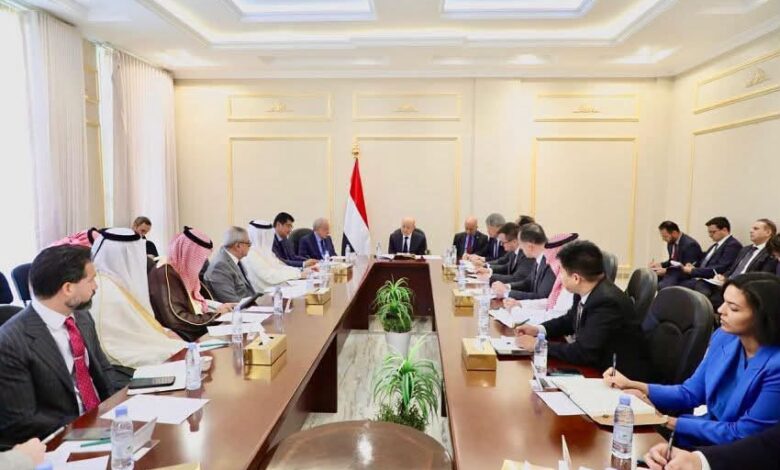
Al-Alimi made the remarks during a meeting in the Saudi capital, Riyadh, with ambassadors of the countries sponsoring Yemeni political process. He called for the strict enforcement of UN Security Council resolutions and sanctions, including preventing airports, seaports, and civil aviation from being used to transport military experts or dual-use equipment. He also urged tighter monitoring of financing and smuggling networks linked to the Houthis.
The Presidential Leadership Council chairman called for an international investigation into what he described as Iranian violations, including the aircraft’s cargo. He claimed the plane switched off its tracking system while flying over Yemeni airspace. He also called for stronger sanctions against the Houthis as a peaceful means of implementing international legitimacy, particularly UN Security Council Resolution 2216, and appealed for increased political and economic support for the Yemeni government.
Al-Alimi said Yemen was asking the international community only to defend the principles on which the international order is based. He warned that allowing armed groups to disregard Security Council resolutions, use civilian aviation as cover for transporting military expertise, and threaten global energy security and international shipping would have consequences extending far beyond Yemen.
He argued that the Yemeni crisis is no longer merely an internal matter but has become a direct challenge to the international system and the global economy. He described the recent flight as an “extremely dangerous development” and a test of the international community’s willingness to enforce its own resolutions and sanctions regime.
According to Al-Alimi, the Yemeni government considers the incident a matter affecting both national sovereignty and the credibility of the international system, warning that ignoring such violations would encourage future breaches and undermine the authority of the Security Council.
He said preliminary government information contradicted the Houthi claim that the flight was humanitarian in nature. According to those preliminary reports, the aircraft carried Iranian military and security personnel, experts specializing in the development of drones and missile systems, electronic equipment, communications technology that could be used for command-and-control systems, and Yemeni personnel who had received security training in Iran.
He added that the concerns were not limited to the passengers and cargo. He alleged that the aircraft’s tracking signal experienced repeated interruptions while crossing Yemeni airspace, describing this as behavior inconsistent with the claim that it was conducting a humanitarian mission and therefore warranting an independent international investigation.
Al-Alimi also said the aircraft belonged to a company that, according to him, had previously been associated with international sanctions and accused of providing logistical support to Iran’s Revolutionary Guard, arguing that this further increased the seriousness of the incident and required greater international vigilance.
He accused Iran of supporting the Houthi group for years through political, military, and media assistance, transferring military expertise and technology, and sustaining what he called Yemen’s “war economy” in pursuit of Tehran’s regional agenda while undermining Yemeni state institutions.
Al-Alimi emphasized that Yemen does not oppose the Iranian people but rejects what he described as the Iranian government’s policy of supporting armed groups, interfering in other countries’ internal affairs, and weakening national institutions.
He also claimed that Iran had made no meaningful contribution to Yemen’s development or humanitarian response over recent decades, while continuing to support the Houthis in ways that, according to him, prolong the war and deepen the humanitarian crisis.
In contrast, Al-Alimi praised Saudi Arabia for its support of Yemen, citing assistance to state institutions, economic stabilization, development projects, essential services, peace efforts, reconstruction initiatives, and the hosting of millions of Yemenis for work, residence, education, and investment.
He argued that the difference between the two approaches is that, in his view, Iran invests in supporting militias and perpetuating conflict, while Saudi Arabia invests in state institutions, development, improving living conditions, and creating an environment conducive to peace.
Al-Alimi rejected what he described as Houthi narratives about defending national sovereignty, arguing that the group’s relationship with Iran extends beyond political support to include ideological, military, security, and logistical ties. He said genuine sovereignty begins with respect for the constitution, state institutions, and the state’s exclusive control over weapons.
He held the Houthi group directly responsible for worsening Yemen’s humanitarian crisis, saying the crisis originated with the group’s takeover of state institutions, the outbreak of war, and its rejection of political initiatives that could have spared Yemen the consequences of the conflict.
According to Al-Alimi, blaming either the Yemeni government or the Saudi-led coalition for the humanitarian crisis ignores what he described as its root cause: the armed coup, continued militarization of society, destruction of state institutions, and damage to the national economy.
He said hundreds of thousands of public-sector employees in Houthi-controlled areas remain unpaid, while the group, according to him, directs substantial resources toward purchasing and smuggling weapons, developing missiles and drones, financing recruitment campaigns, and maintaining military training camps.
Al-Alimi also referred to reports alleging that the Houthis had allocated significant funds to support cells and activities aimed at destabilizing security in government-controlled areas and financing assassinations of civilian leaders, rather than using those resources to improve public services and pay salaries.
He said these practices demonstrate that the group’s priority is sustaining the war economy, rather than addressing citizens’ needs.
Turning to humanitarian issues, Al-Alimi accused the Houthis of interfering with humanitarian operations, saying their actions had disrupted aid programs and forced several organizations to reduce or suspend their activities, affecting millions of beneficiaries.
He further accused the group of using humanitarian assistance as a tool of pressure and control, arguing that such practices contradict its claims of supporting humanitarian work.
On the political front, Al-Alimi said the Houthis’ record since taking control of state institutions demonstrates a repeated rejection of national and international reference frameworks, failure to honor commitments under UN Security Council resolutions, and exploitation of agreements and ceasefires to rebuild their military capabilities.
He claimed the group used periods of calm to strengthen its fortifications, redeploy forces, continue unilateral measures against economic institutions, and threaten international shipping, which he said showed a lack of genuine commitment to ending the war.
Al-Alimi reiterated that achieving peace requires adherence to the agreed national, regional, and international frameworks, ending the coup, respecting state institutions, and allowing the Yemeni people to determine their future freely. He affirmed the Presidential Leadership Council’s and the government’s commitment to pursuing peace on the basis of those frameworks.
He said the government has supported the Gulf Initiative, the outcomes of the National Dialogue Conference, and UN Security Council resolutions, participated in successive rounds of negotiations, and backed ceasefires and initiatives aimed at ending the war. He concluded by warning that the continued absence of effective international deterrence raises questions about what actions the Houthi group may take in the future.