Yemen Monitor / Reports Unit / Exclusive:
One full month after the outbreak of direct military confrontation between the U.S. and Israel on one side and Iran on the other, the war has taken a major “strategic turn” with the Houthi armed group’s official announcement of its involvement in the conflict, launching barrages of ballistic missiles and drones towards Israeli targets in Eilat and the Negev.
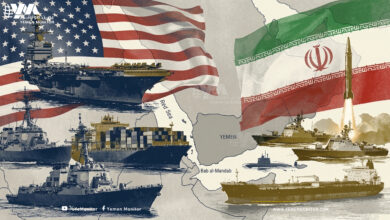
This development is no longer merely a symbolic “message of solidarity” but has transformed into an existential threat to the arteries of the global economy, with the Bab el-Mandeb Strait being placed on the table of military options as a tool of pressure to impose a ceasefire or extract complex political and economic gains.
What does this signify? Experts answer this question in this report, addressing the motives of the Yemeni movement and its local and regional repercussions.
A Functional Shift: Yemeni Geography in the Service of Iran
Hisham Al-Omeisy, a consultant on Yemeni affairs at the European Institute for Peace, believes the Houthis are following a “gradual approach” in this conflict. He states that their current entry aims to expand the fronts to alleviate military pressure on other members of the “Axis of Resistance,” especially in light of intense attacks targeting infrastructure in Iran. Al-Omeisy affirms that this move allows the group to garner domestic support and portray itself as a defender of Islamic causes, thereby diverting attention from economic and governance challenges inside Yemen.
On his part, Dr. Hani Albasos, a professor of international relations, analyzes this entry as an Iranian attempt to utilize all available pressure cards against the US and Israel, particularly as military operations reach their peak and Washington threatens to strike Iranian energy facilities.
Albasos believes the Houthis represent a “key extension and arm” of Tehran in the region. He notes that the timing of their intervention reflects Iran’s exhaustion of some of its missile options and its need to activate its allies in Yemen, Iraq, and Lebanon for collective pressure.
In the military context, Michael Mulroy, former US Deputy Assistant Secretary of Defense, views this move as fully coordinated with Iran, which considers the Houthis a “strategic asset” it has supported for years.
Mulroy points out that the greatest danger lies in the group’s ability to disrupt commercial shipping in the Red Sea and Bab el-Mandeb. This adds global economic complexities beyond the capacity for purely military action, as it requires convincing insurance companies and commercial vessels that the corridor is safe—a significant challenge for the international community.

Bab el-Mandeb: A “Ticking Time Bomb”
Dr. Yousef Al-Shammari, President of the London College of Energy Economics, confirms that Bab el-Mandeb Strait is a vital artery through which approximately 12% of global trade passes, including oil, gas, grains, and fertilizers. Al-Shammari believes that any threat in the Red Sea would force ships to reroute via the Cape of Good Hope, increasing shipping time and costs, inevitably keeping oil prices above $100 for several months due to the “geopolitical risk premium.”
Dr. H.A. Hellyer, an Associate Fellow at the Royal United Services Institute (RUSI), describes the strait as an extremely narrow passage (about 18 miles at its narrowest point) with no practical nearby alternative. Hellyer points out that the danger lies in the Houthis not engaging in random escalation but following a precise, calculated pattern, making them more dangerous. He also believes that any disruption to this corridor would have “cascading effects” on the global economy beyond just the energy sector.
Regarding the “cost of confrontation,” Hisham Al-Omeisy explains that the Houthis have become adept at using swarms of drones and suicide boats costing only a few thousand dollars each, while intercepting them requires expensive anti-air missiles. This material imbalance gives the group the ability to sustain a prolonged naval war of attrition, as protecting all ships at all times from the group’s varied attacks is difficult—a fact the Houthis realize and exploit skillfully.
Military expert Sean Bell asserts that previous attempts by Washington and London to degrade Houthi capabilities did not succeed in taking them “off the chessboard.” The group managed to rebuild its stockpiles and develop local capabilities, making protecting all commercial vessels at all times a nearly impossible mission for the international coalition.

War as a Tool for “Political Blackmail”
From the perspective of the de facto authority, Mohammed Mansour, Undersecretary of the Ministry of Information in the Houthi government, states that Yemen’s intervention is “qualitative,” not symbolic, and explicitly links maritime security to “lifting the blockade on Yemen.” Mansour claims the group acts as an “independent state,” deciding the timing of its intervention based on its strategic relationship with Iran. He warns that the Red Sea and Bab el-Mandeb in upcoming stages in the “near future” are tied to ending economic restrictions on the group.
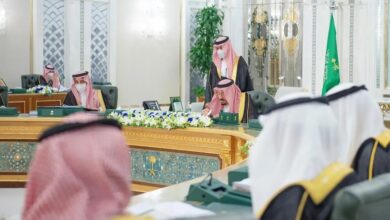
Regarding relations with neighbors, former British Ambassador Nicholas Hopton suggests that the Houthi escalation could jeopardize the chances of transforming the fragile truce with Saudi Arabia into a lasting peace agreement. The Houthis had been demanding Riyadh pay government employee salaries and provide financial compensation. Now, they are using the threat of targeting Saudi oil pipelines (East-West) and Red Sea ports as additional leverage to pressure the kingdom into succumbing to their demands.
Hisham Al-Omeisy explains that the Houthis are sending a message to Riyadh: they are capable of harming Saudi oil export routes through the Red Sea if their demands are not met. They are exploiting the kingdom’s need for regional stability to complete its economic projects, thereby making the maritime file an exceptional tool of political pressure.
Amid the faltering diplomatic efforts led by Pakistan and Iran’s rejection of “Trump’s” 15-point plan, escalation appears to be the “only language” left. While Washington threatens to occupy Iranian islands or vital installations like Kharg Island, the Houthis respond by affirming their readiness to open an endless “front of attrition.”
In conclusion, the Houthis’ entry into the war remains a “trump card” for Tehran and a disruptive factor for Washington. However, it carries severe risks for Yemen, which may find itself an arena for settling major international scores, especially with Israeli threats to open a direct confrontation front in northern Yemen—the price of which would be paid by citizens and infrastructure.