Yemen Monitor / Newsroom
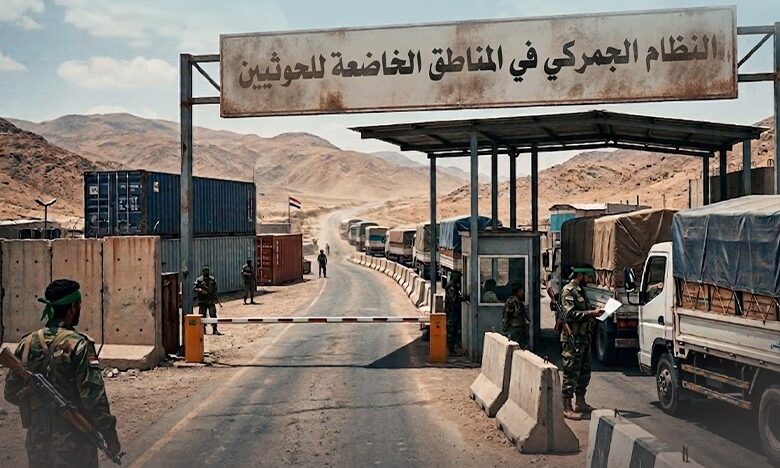
A recent study issued by the Mokha Center for Strategic Studies revealed an unprecedented expansion of the Houthis’ network of internal customs checkpoints and collection points, confirming that the system has evolved during the years of war from limited revenue checkpoints into a “parallel economy” that finances the conflict and strengthens the group’s authority outside the institutions of the legitimate state.
According to the study, titled “War Economy: Customs Checkpoints in Houthi-Controlled Areas,” the group had established by 2024 more than 220 active internal customs points spread across at least ten Yemeni governorates. The network operates as part of an integrated financial and security system linking field-level collections with a financial data center in Sana’a.
The study explained that the network no longer performs a traditional customs function, but has instead become a tool for imposing economic control and reshaping the Yemeni market through what it described as “internal economic borders,” by levying multiple fees and taxes on the movement of goods between governorates.
The study estimated annual revenues generated from these internal customs duties at between 90 and 120 billion Yemeni rials — equivalent to approximately $65 to $85 million — noting that the Houthis’ share of total national customs revenues rose to between 74% and 85% during 2024.
The report stated that the duplication of customs charges has increased transportation costs by an average of 25% to 30%, while increases on some transport routes exceeded 200% due to the large number of collection points, fines, and ongoing delays. This has directly contributed to a rise in the prices of essential goods by around 10% to 15%.
The study added that these policies have deepened Yemen’s economic and humanitarian crisis, with the country losing nearly half of its real GDP compared to the pre-war period, while more than 70% of the population now lives below the poverty line.
According to the report, most of the collected revenues are not directed toward public services or salary payments for civil servants, but are instead allocated to funding military fronts and security activities, while public services receive no more than about 10% of the revenues.
On the legal front, the study argued that the internal customs system constitutes a clear violation of Yemen’s Customs Law No. 14 of 1990, which restricts customs collection to official border crossings, ports, and airports. It also conflicts with the principles of freedom of movement, market unity, and a unified state treasury.
The study also warned of the humanitarian consequences of these measures, noting that collection checkpoints delay humanitarian aid convoys by between 48 and 72 hours and impose additional fees on trucks ranging from $300 to $600, significantly increasing the cost of food and medicine for civilians.
The report called for a multi-stage approach to address the phenomenon, beginning with expanded international sanctions against individuals involved in illegal tax collection, freezing their assets, and strengthening oversight of goods movement, alongside modernization and automation of customs systems at ports and crossings controlled by the internationally recognized government.
In the post-war phase, the study recommended reunifying customs tariffs, reconnecting border crossings to state institutions, and establishing a transitional revenue authority to dismantle war economy networks and prevent their influence from re-emerging within state institutions.