Yemen Monitor / Berlin / Exclusive:
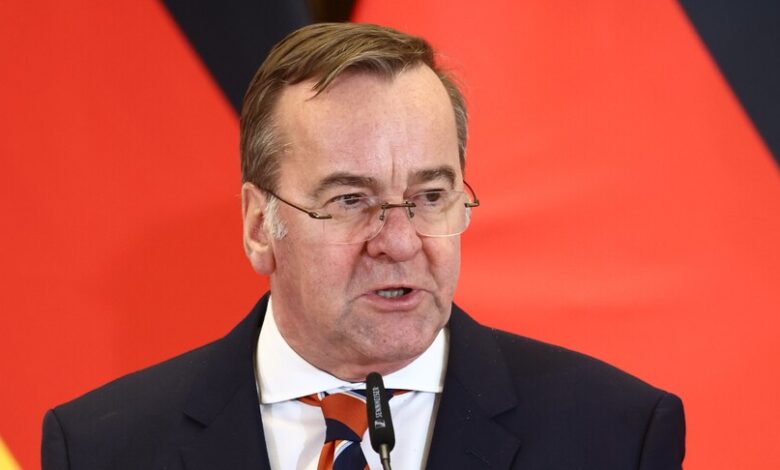
German Defense Minister Boris Pistorius stated on Thursday that his country is in the process of deploying two ships to the Red Sea in preparation for a potential military mission in the Strait of Hormuz.
Hours after US President Donald Trump signed an agreement with Iran to end a war that caused disruptions to global energy supplies, officials in the shipping and insurance sectors called for the urgent deployment of minehunter ships in the strait.
“As we speak, the minehunter (Fulda) and the supply ship (Mosel) are sailing through the Suez Canal toward the Red Sea,” Pistorius told reporters upon arriving for a meeting with his NATO counterparts in Brussels.
Pistorius, who did not specify a timeframe, explained that obtaining approval from Iran and Oman is required before any participation in a mine clearance operation, adding that any mission would also depend on developments in the ongoing talks between Iran and the United States.
Sources in the shipping and maritime security sectors told Reuters that ensuring the strait is clear of mines could delay the return of normal shipping traffic by several weeks.
Germany is also sending underwater drones, specialized mine clearance divers, and vessel protection teams.
At a time when France and Britain are pushing plans for a multinational naval mission, diplomats mentioned that Iran has shown strong opposition to any foreign military presence in the waterway, and hinted that it might seek to impose transit fees on ships, which constitutes a red line for European powers.
For their part, Greek government officials said that Athens is on standby to send naval vessels to support mine clearance efforts; however, government spokesman Pavlos Marinakis reported on Thursday that no concrete decision has been made at the operational level yet.
Sheila Cameron, Chief Executive of the Lloyd’s Market Association (LMA), said that the threat of mines remains a major obstacle to the resumption of trade in the region.
“Continuous monitoring of sea lanes is required to provide reassurance and confidence to shipowners and their crews,” added Cameron, whose association represents the interests of all underwriting businesses in the London Lloyd’s insurance market.
Jakob Larsen, Head of Maritime Safety and Security at BIMCO, said that credible assurances must be provided by both sides of the conflict before traffic can fully return to pre-conflict levels.
Larsen continued: “The danger of mines in the region remains a concern for now and in the long term, and it is essential to define mine-free routes.”