Yemen Monitor/ Newsroom:
The Minister of Industry and Trade in the Yemeni government, Dr. Mohammed Al-Ashwal, confirmed that basic custom-exempt goods will not be affected by the decision to move the custom dollar rate, and that the decision is limited to luxury goods and by limited percentages that do not affect the basic needs of citizens.
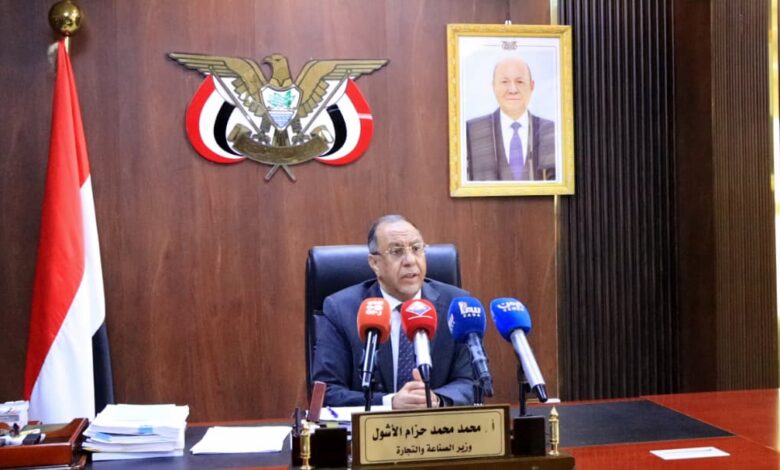
Minister Al-Ashwal pointed out, during a press conference held in the temporary capital, Aden, today, that the decision to move the custom dollar rate comes within the framework of the approved economic reforms, in implementation of the Presidential Leadership Council’s Resolution No. (11) of 2025.
He also emphasized that the government puts improving the living conditions of citizens at the top of its priorities, in parallel with implementing economic and financial reforms aimed at enhancing economic stability and protecting the local market from imbalances and monopolistic practices.
He explained that the cabinet’s recent decisions included a package of economic and living remedies, which included paying a 20 percent cost-of-living allowance to state employees, approving the annual bonuses due for the years 2021–2024, and addressing job settlements that have been suspended for more than 13 years, reflecting the government’s direction toward fulfilling its obligations to employees and alleviating the living burdens of citizens.
The Minister of Industry and Trade called on the private sector and merchants to commit to national and moral responsibility, and not to exploit the decision to impose unjustified increases on the prices of basic goods… stressing that the ministry is continuously monitoring market movement and price changes in coordination with the relevant authorities.
He confirmed that the ministry has formed field committees and monitoring teams in various governorates to visit markets, clamp down on violations, and prevent monopoly and price-gouging, in cooperation with local authorities, public prosecutions, and security apparatuses… emphasizing that the ministry will not tolerate any violations that affect market stability or burden citizens.
Al-Ashwal noted that the ministry has an electronic monitoring platform to receive reports and complaints from citizens, in addition to taking strict legal measures against violators, including suspending commercial registries and blacklisting violators if violations continue.
He reaffirmed the importance of partnership with the private sector as a fundamental pillar of market stability… calling on everyone to cooperate to maintain the stability of basic commodity prices and boost confidence in the local market in light of exchange rate stability and continuous government efforts to control economic conditions.
The Yemeni government had previously approved floating the custom dollar rate on non-essential goods, thereby raising customs from 750 per dollar to 1,560 riyals per dollar.