Yemen Monitor / Aden / Exclusive:
Cases of rebellion against the Yemeni government’s new appointment decisions have been increasing, affecting a number of officials in the governorates of Aden and Lahj (southern Yemen). Authorities have increasingly resorted to the judiciary and the Public Prosecutor’s Office to issue compulsory arrest warrants against officials refusing to comply, only for these appointment decisions to eventually be frozen.
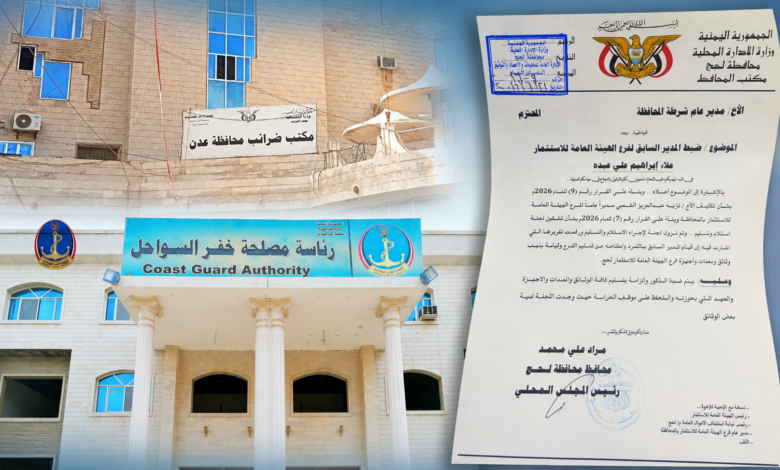
Appointments for the new head of the Coast Guard Authority, the director of the Tax Office in Aden, and the investment authority official in Lahj remain stalled, with handover procedures still incomplete because the outgoing officials have refused to vacate their positions. Meanwhile, the government has been unable to enforce the changes using the security or military apparatus.
The growing pattern of defiance whenever appointment decisions affect important and sensitive positions—such as revenue-generating institutions or major security agencies—has raised numerous questions. This comes amid claims that key civil and security institutions remain under the control of individuals loyal to the Southern Transitional Council (STC). According to observers, this is evident in the government’s inability to enforce these appointments, despite seeking compulsory orders from the Public Prosecutor. Similar orders have previously been issued against STC leaders who continue to move freely and perform their duties in Aden and other southern governorates, while the security and political fragility in areas formerly controlled by the STC persists.
Tax Office Director Defies Appointment
In the latest development, the Public Prosecutor issued compulsory arrest warrants for the former Director General of the Tax Office in the temporary capital, Aden, Abdul Hakim Muawin, after he refused to hand over his responsibilities to the newly appointed director, Mohammed Ahmed Obaid Al-Fadhli.
The arrest order followed an official complaint filed by Prime Minister Shaya Al-Zandani and the Minister of Finance after the handover process stalled. According to informed sources, the resistance within the Tax Office is supported and politically protected by Aden Governor Abdulrahman Sheikh, who argues that management of revenue-generating offices falls exclusively under the authority of the local government. The central government, however, maintains that it has the constitutional and legal authority to oversee sovereign revenues and appoint their directors.
Coast Guard Appointment Frozen
Tensions reached their peak on June 21, when limited armed clashes erupted in Aden between a security force accompanying the newly appointed head of the Yemeni Coast Guard, Brigadier General Qais Ismail (appointed by the Minister of Interior), and several Coast Guard personnel stationed at the agency’s main gate.
The confrontation reflected open rebellion by the Coast Guard chief, Major General Khaled Al-Qamli, who rejected his dismissal and refused to hand over command to his successor. As a result, the Presidential Leadership Council intervened urgently and froze the appointment decision, a suspension that remains in effect.
Pursuit of Lahj Investment Director
In Lahj Governorate, Governor Major General Murad Ali Mohammed issued an official memorandum to the provincial police chief ordering the arrest of the former Director General of the local branch of the General Investment Authority, Alaa Ibrahim Ali Abduh.
The order came after he allegedly refused to hand over the office to the newly appointed acting director, Nazih Abdulaziz Al-Shaibi, and was accused of removing documents and equipment belonging to the authority.
Who Is Controlling the Defiance?
Although the Southern Transitional Council officially lost its influence in early January and its dissolution was announced, individuals loyal to it continue to control many key institutions and occupy senior positions in vital civil and security sectors.
Observers believe the new appointments have collided with the influence of officials loyal to the STC, who continue to dominate sensitive administrative positions as well as revenue and security institutions in Aden and Lahj. They argue that any attempt to alter these positions triggers either armed or administrative resistance against the internationally recognized government.
Observers also note that despite broad personnel reshuffles affecting several police departments in Aden, the STC-affiliated armed formations—particularly the Security Belt Forces—continue to exercise overwhelming security control over the temporary capital under the leadership of Jalal Al-Rubaie, the same leader who managed the security file during the period of the STC’s sole control over the city, and likewise for civil institutions.