Yemen Monitor/ Sana’a/ Exclusive:
The Houthi group has escalated its rhetoric against the Yemeni government and Saudi Arabia, coinciding with the US-Iranian agreement following the end of the 120-day war in which Tehran supported them. This agreement has been presented by the group as a “victory” over Washington.
In his speech marking the Islamic New Year today, Tuesday, the group’s leader, Abdul-Malik al-Houthi, hinted at military action to end what he described as “the blockade, aggression, and occupation,” warning that his group’s patience has nearly run out.
This escalation in political and military rhetoric against the Kingdom of Saudi Arabia and the legitimate Yemeni government coincides with regional developments between Washington and Tehran, in which the Houthis participated by supporting Iran, threatening to close Bab el-Mandeb strait and launching attacks targeting the Israeli occupation.
The Houthi leader utilized economic justifications, which consisted of accusing the government of controlling the wealth in its regions, calling on his supporters to mobilize officially and popularly for military escalation.
This escalation coincided with statements by the group’s military spokesperson, Yahya Saree, who stressed that his group “will not stand idly by,” amid talk of a Saudi-Houthi rapprochement and the latter’s demands to pay the bill of the war, including salaries that have been suspended for ten years.
Mohammad Miftah, the appointed acting prime minister of the Houthi government (unrecognized), had threatened that the coming phase is the “phase of breaking the blockade,” hinting at moving the battle to the economic depth of the Kingdom and targeting vital interests in the Red Sea and Bab el-Mandeb.
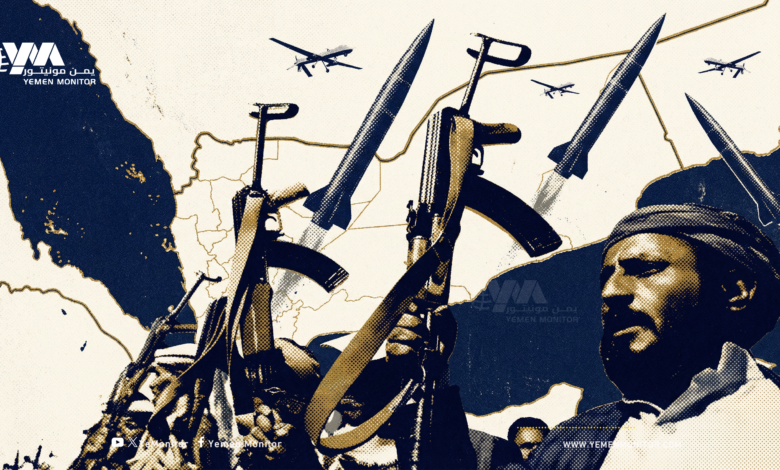
The Houthi group’s media outlets are talking about entering this phase (military escalation) based on what they describe as “great victories” in the Red Sea and the possession of “hypersonic” missiles as a strategic weapon, while hinting at presenting “new surprises” in confronting Saudi Arabia, which the group accuses of continuing the war.
Media platforms affiliated with the militia are promoting that their leader’s statement constitutes a “final warning” to the Saudi regime, vowing that the next phase will move the battle directly to the Kingdom’s “economic depth” by targeting its vital interests in the Red Sea and Bab el-Mandeb to impose the group’s conditions and end the coalition’s operations.
These statements come alongside the revival of negotiations between the Houthis and the Yemeni government in Muscat under UN auspices, where the Joint Military Committee held several meetings. Both parties are also awaiting the implementation of the prisoner and detainee exchange agreement in a few days, which represented a breakthrough in the negotiation file.
Observers believe that the hint at escalation is an attempt to pressure Saudi Arabia to return to the understandings reached with the Houthis prior to the events of October 7, which included a draft agreement comprising three phases ending in a political solution—which the Houthis rejected at the time, and are now looking to return to.