Yemen Monitor – Newsroom:
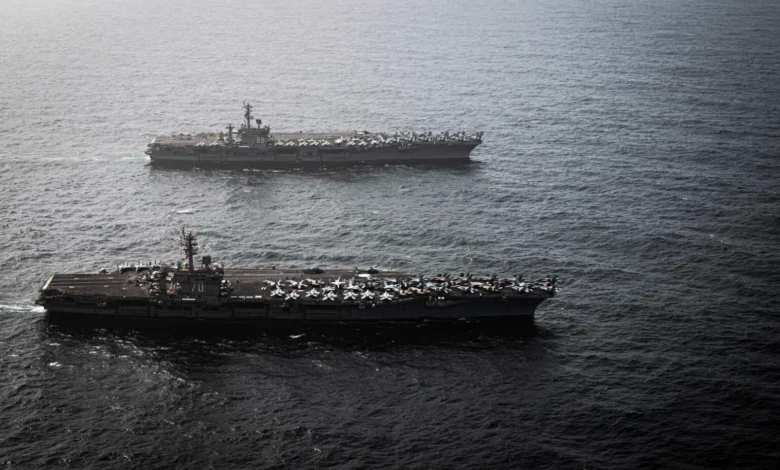
The U.S. aircraft carrier USS Carl Vinson has departed the Middle East after a three-month deployment under U.S. Central Command, heading toward the Indian Ocean. At the same time, the U.S. has reduced the number of its guided-missile destroyers in the Mediterranean to just one vessel.
According to a U.S. defense official speaking to USNI News, the Carl Vinson, which spent 238 days at sea, was part of the largest carrier deployment on the U.S. West Coast since the Houthi attacks began in the Red Sea in late 2023.
This withdrawal comes amid continued tensions between Israel, Iran, and the US, with American carrier strike groups now stationed in the Arabian Sea instead of the Red Sea.
Meanwhile, Washington has relied on two independent destroyers, the USS Forrest Sherman and USS Truxtun, to handle threats in the Red Sea, while the number of U.S. guided-missile destroyers in the Mediterranean was reduced from five to one, signaling a notable drawdown of US military presence in this vital region.
This comes as the Houthis escalate their attacks, recently striking two Greek-owned, Liberia-flagged commercial vessels in the Arabian Sea. The attacks resulted in the sinking of the MV Magic Seas and the deaths of four crew members aboard the Eternity Sea. The Houthis used small boats, cruise and ballistic missiles, and drones, claiming the shipowners violated their ban on visiting Israeli ports.
No U.S. Navy or Coast Guard forces responded to assist the targeted ships, according to a Wall Street Journal report, raising questions about Washington’s current ability to safeguard vital maritime routes amid its reduced military footprint.
Analysts suggest the Houthi attacks may be a political message aimed at pressuring for a broader ceasefire in the regional conflict, especially as an upcoming meeting between the Israeli Prime Minister and U.S. President is expected to focus on a truce with Hamas.
Experts also believe Tehran is encouraging the Houthis to bolster its regional influence, exploiting the ongoing conflict between Israel and the U.S.
The U.S. State Department reaffirmed Washington’s commitment to protecting freedom of navigation against Houthi attacks, labeling them a continuing terrorist threat to regional maritime and economic security. A senior U.S. official told the Wall Street Journal that a ceasefire is still in effect, despite the rise in attacks.
These developments highlight the growing complexity of the military and political landscape in the Middle East, where Iran-backed Houthi actions are directly affecting U.S. strategy and the balance of naval power in the region.