Yemen Monitor/ Newsroom:
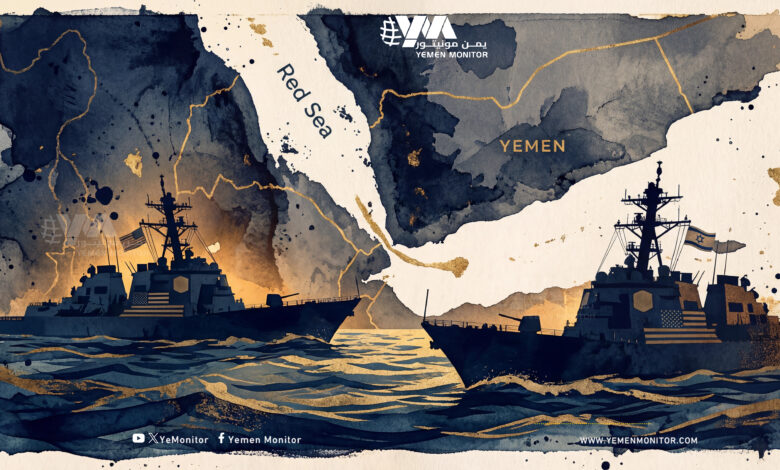
A position paper issued by the Al-Mocha Center for Strategic Studies revealed that Bab al-Mandab Strait and the Red Sea have witnessed rapid geopolitical transformations over the past three years, making this maritime corridor one of the most prominent arenas of regional and international conflict, after surpassing its traditional role as a vital corridor for global trade.
The report explained that Bab al-Mandab has become a geo-economic leverage tool used by multiple regional parties, foremost among them the Houthi group, which has remarkably developed its naval and missile capabilities, enabling it to expand the scope of its threats to international navigation beyond the borders of the Yemeni conflict.
The assessment pointed out that by the year 2026, the crisis has transformed into a permanent strategic reality, with the concept of deterrence shifting from direct military confrontation to what it described as “geo-economic deterrence,” which is based on raising the costs of transit, insurance, and shipping, rather than completely closing the shipping lane.
According to the report, these developments have reverberated across global trade, as ship traffic through the Suez Canal has sharply declined, while international shipping companies have been forced to reroute toward the Cape of Good Hope path, leading to higher transport and insurance costs and exacerbating pressures on global supply chains.
The center emphasized that Israel was among the parties most affected by the crisis, with activity at the Port of Eilat dropping to unprecedented levels and the costs of imports coming from Asia soaring, at a time when Iran continued to utilize the Houthis as part of a strategy aimed at expanding regional leverage cards without engaging in a direct confrontation.
On the other hand, the report considered that the United States faced significant challenges in containing the maritime threats, as the military operations it led over the past years did not succeed in decisively ending Houthi capabilities, despite the losses inflicted upon them.
The assessment also monitored a divergence in Washington’s and Tel Aviv’s approaches to the crisis, with Israel leaning toward executing direct strikes inside Yemen, compared to the United States preferring a strategy of containment and preventing the expansion of the confrontation.
The report noted that the escalation reached a more sensitive stage during 2026 with the rise of simultaneous threats to the Straits of Hormuz and Bab al-Mandab, prompting regional and international parties to support tracks of de-escalation and dialogue to avoid broader repercussions on the security of global navigation and trade.
Al-Mocha Center concluded that Bab al-Mandab crisis is no longer an issue solely related to maritime security, but has rather become a test for the balance of power in the region and the international community’s ability to protect strategic corridors, stressing that a sustainable solution requires a comprehensive political address of the root causes of the conflict in Yemen and the regional influence networks associated with it.