Yemeni Presidential Council Approves Reform Package And Praises Progress In Unifying Security And Military Command

Yemen Monitor/ Newsroom:
The Yemeni Presidential Leadership Council (PLC) approved on Tuesday a comprehensive matrix of reforms targeting financial, service, and security sectors. At the same time, it praised what it described as “tangible progress” in the path toward unifying security and military decision-making amid escalating security and regional challenges.
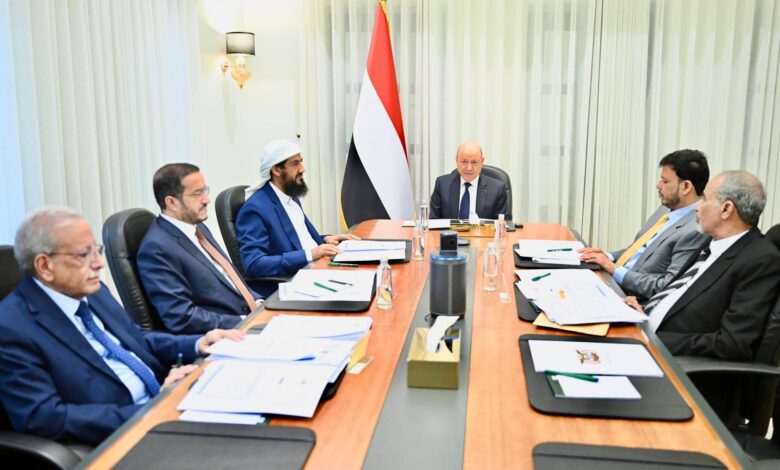
The Council held a meeting chaired by President Rashad al-Alimi, attended by members Abdulrahman al-Mahrami, Abdullah al-Alimi, Othman Mujali, and Mahmoud al-Subaihi, while Sultan al-Aradah, Tareq Saleh, and Salem al-Khanbashi participated via video conference.
The Council stated that it discussed local developments and government reforms aimed at improving living conditions and basic services, enhancing the presence of state institutions, and consolidating security and stability in areas under government control.
Al-Alimi reviewed the results of his visit to Djibouti, which included talks with Djiboutian President Ismail Omar Guelleh and Somali President Hassan Sheikh Mohamud. These discussions focused on coordinating positions regarding the security of the Red Sea and the Gulf of Aden, in light of escalating smuggling activities, organized crime, and transborder threats.
The Council praised the results of the visit, considering that it strengthened “Yemeni presence” in the security equation of the Red Sea and the Horn of Africa and underscored the importance of regional coordination to protect international navigation and combat terrorism and smuggling.
The Council also listened to a report on the results of a small-scale government meeting that included governors of government-controlled provinces. This meeting discussed the level of progress in financial and service reforms, the enhancement of governance and transparency, and the implementation of decisions related to the partnership with Saudi Arabia and international donors.
On the security file, the meeting discussed developments in the temporary capital, Aden, including recent assassination incidents which it claimed aim to “disrupt the scene and undermine confidence in national and international institutions.”
The Council commended the performance of the security services in pursuing involved elements and thwarting “terrorist” plots, noting improved coordination between state institutions following steps to unify military and security decision-making with Saudi support.
The Council reaffirmed its commitment to continuing the fight against terrorism, securing vital facilities, and protecting relief workers and the private sector, emphasizing its persistence in the “battle to restore state institutions” and end what it described as the suffering caused by the Iranian-backed Houthis.
Furthermore, the Council approved proposals submitted by the Prime Minister to enhance administrative and institutional performance across several sectors at both central and local levels.
On the regional level, the meeting discussed developments related to what it described as Iranian “hostile attacks” against countries in the region, considering them a reflection of a continued policy of “destabilizing regional security and stability.”
The Council renewed its condemnation of Iranian attacks and threats targeting civilian and economic facilities in Kuwait, the UAE, and Bahrain, viewing them as a violation of international law and a threat to regional security.