Yemen Monitor / Aden / Exclusive:
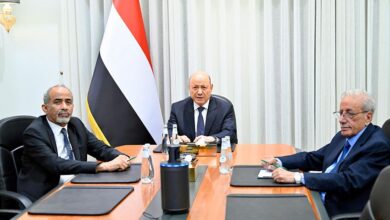
Rashad al-Alimi, Head of Yemen’s Presidential Leadership Council, departed the interim capital Aden on Friday bound for Saudi Arabia via a military base and under coalition protection, for urgent consultations with regional and international actors regarding the fast-moving developments in the eastern provinces, particularly Hadramawt.
A senior official in the internationally recognized government told Yemen Monitor that al-Alimi left through Badr Air Base, adjacent to Aden International Airport, escorted by Saudi military forces—a sign of the heightened political and security sensitivities gripping the interim capital.
According to the source, al-Alimi informed regional mediators that he had been subjected to “harassment” by forces aligned with the Southern Transitional Council (STC) inside and around the Ma’ashiq Presidential Palace, coinciding with the recent military escalation in the east.
The official spoke on condition of anonymity because he was not authorized to brief the media.
In a statement from his office, al-Alimi reaffirmed the council’s and the government’s commitment to the principles of national partnership and the references governing the transitional period, foremost among them the Transfer of Power Declaration and the Riyadh Agreement. He stressed in firm language that the state alone bears responsibility for safeguarding national institutions and public interests.
The Presidential Leadership Council chairman expressed categorical rejection of any “unilateral measures” that undermine the powers of the government or local authorities, warning that such actions threaten security and stability, deepen the humanitarian crisis, and serve only “the Iranian project and its destructive tools”—a reference to internal infighting that distracts from the main battle against the Houthis.
The use of the term “unilateral measures” and the emphasis on the “valley and desert” districts (Wadi and Sahara of Hadramawt) point to the presidency’s opposition to attempts to impose a new military reality in the eastern regions—developments that prompted a Saudi intervention to de-escalate, an arrangement that appears to remain fragile.
Regarding tensions in Hadramawt, al-Alimi praised Saudi efforts that resulted in a “de-escalation agreement,” underscoring the need for full adherence to its terms and for enabling local residents to manage their own affairs.
Al-Alimi also issued immediate directives to local authorities and relevant government bodies to form a committee to investigate human rights violations and breaches of international humanitarian law, and to document damage inflicted on civilians and public and private property, particularly in the Wadi and Sahara districts.
The presidential order stressed the need to take necessary measures to compensate victims, ensure that perpetrators are held accountable, and support mediation efforts led by tribal leaders and local dignitaries to restore normalcy.