Prosecution of “STC” Leaders in Aden… Pending Coercive Orders Between Renewal and Cancellation and Contradictory Evidence

Yemen Monitor / Reports Unit / Special:
The case of prosecuting four leaders of the (dissolved) Southern Transitional Council (STC) has returned to the forefront after the Public Prosecution renewed coercive arrest warrants, just days after canceling them, in a precedent that revealed significant confusion in handling the case and contradictory justifications within Aden’s police memos.
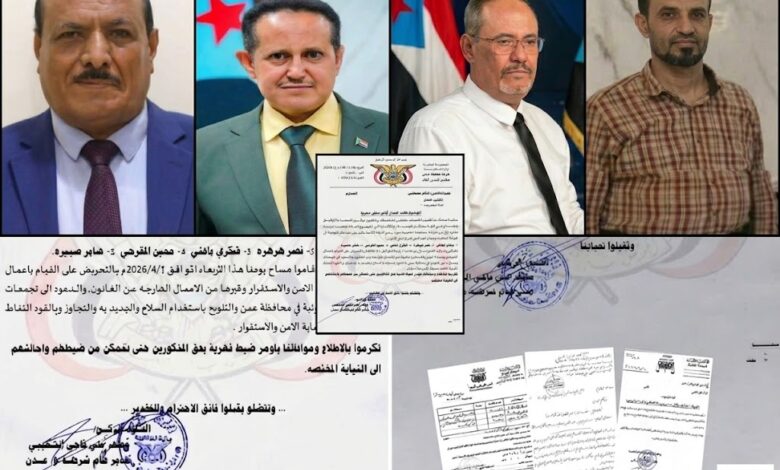
The so-called General Secretariat of the STC stated during a meeting on Thursday that Aden authorities—which it describes as “de facto authorities”—had renewed the coercive arrest warrants, considering this provocative measures that violate what it said were established norms and laws. Four leaders—Waddah Nasr Al-Halami (acting Secretary-General of the council), Nasr Hurhura, Shukri Ba’ali, and Sabir Subairah—face charges and prosecution in Aden.
Informed sources told “Yemen Monitor” that the Public Prosecution renewed on Monday, May 11, 2026, the coercive arrest warrants against four STC leaders present in Aden, who face charges of breaching security and inciting against the system.
The Story of Issuing and Canceling Coercive Arrest Warrants
On April 1, 2026, Aden’s Security Director submitted a strongly worded memo to the Attorney General, Qaher Mustafa, requesting the issuance of coercive arrest warrants against STC leaders (headed by Waddah Al-Halami), accusing them of “grave” offenses and destabilizing security.
On April 15, the so-called Legal Department of the STC, headed by Raafat Ali Ladas, submitted a formal memo to the Deputy Specialized Public Prosecutor, demanding the immediate halt of the coercive arrest warrants.
The memo stated that the arrest warrants were issued without any prior official summons of the named individuals, which constitutes a violation of established legal procedures. It affirmed that the targeted leaders had not committed any unlawful acts and that their residences and workplaces are publicly known and not hidden.
The STC’s Legal Department criticized Aden’s security procedures, arguing that restricting individuals’ freedom while leaving the matter pending “completion of investigation records” is a void measure that violates the spirit of the law.
According to the STC’s legal memo, the Deputy Prosecutor requested information from Aden Police, sending an urgent inquiry the same day to Aden’s Police Director asking for “information” on whether the warrants had been executed, to enable the prosecution to make its legal decision.

On April 29, the Security Director responded, officially admitting that he “had not been able to collect the primary data on the defendants”! This admission raises a major question: how were “grave” charges initially made without an investigative file or “primary data” to support them?
Based on the security administration’s “inability” to complete its records, the Specialized Public Prosecution issued a decision on May 4 canceling the coercive arrest warrants. However, this cancellation did not amount to an acquittal; rather, it reflected a security failure to construct a coherent legal file, proving that the initial warrants lacked proper legal methodology.
While the STC speaks of the renewal of the warrants, we were unable to obtain the memo containing the new coercive arrest orders or the charges involved, revealing significant confusion or a lack of seriousness in handling the case, as the accused continue their work in Aden without heeding the movements of security and the prosecution.

Meetings of the “Wanted” Leaders and Renewal of Orders
Throughout the period from the issuance of the coercive orders to their cancellation, the leaders continued their normal work and activities within the Southern Transitional Council, even organizing an event on May 4 to mark the anniversary of the council’s founding, raising questions about the efficacy of those orders and the purpose behind their issuance, amid significant confusion on the part of the law enforcement authorities.