Yemen Monitor / Analytics Unit / Special Report:
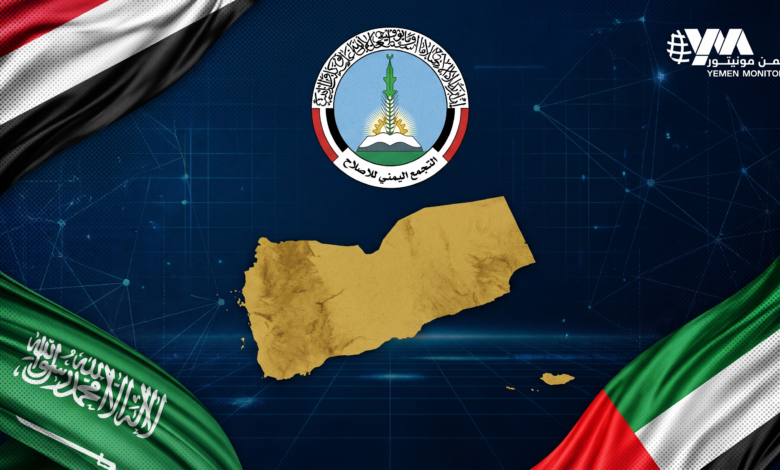
As the Yemeni crisis enters a sensitive turning point characterized by the stalling of major political settlements, there has been an escalation in diplomatic and media maneuvers led by the United Arab Emirates (UAE). These efforts aim to secure a decision placing the Yemeni Congregation for Reform (Al-Islah) on U.S. terror lists in an attempt to marginalize the party regionally and internationally.
However, this move—which extends far beyond a traditional classification—appears to be a strategic tool for redrawing the map of influence in Southern and Northern Yemen amid an intense ideological struggle over the region’s political identity. An alliance led by the Israeli occupation, Abu Dhabi, and Addis Ababa is attempting to build dominance over a “New Middle East” based on the dismantling of states. This stands in opposition to another alliance led by Riyadh, Ankara, Islamabad, and Cairo, which supports national states and maintains their components to build regional security from within.
Bartering Pain for a U.S. Decision
The UAE is driven by the “January Crisis,” referring to its expulsion from Yemeni coasts and islands and the dissolution of its primary ally, the Southern Transitional Council (STC). A mentality of “political revenge” dominates decision-making circles in Abu Dhabi. For the Emirati leadership, the Islah party is not just a local rival; it is the “objective equivalent” that caused them to lose influence in Yemen and obstructed the ambitions of their separatist allies. Consequently, Abu Dhabi seeks the designation as a “moral and symbolic victory” to compensate for its setbacks and to repair the image of “Emirati Firmness” for its domestic audience by offering “Islah’s head” as a sacrifice to settle regional accounts that have yet to cool.
To achieve this, Abu Dhabi is cleverly exploiting its involvement on the front lines of the regional war ignited by Washington and Tel Aviv against Iran in 2026, practicing a form of “political bartering” with its own pain. It utilizes American and Western sympathy—stemming from the heavy strikes on its facilities—to pass a local exclusionary agenda in Yemen and other Arab countries where it seeks influence. Abu Dhabi promotes a narrative in Washington that its stability as a “victim” ally requires purging Yemen of “Sunni Radicalism” (Islah). The UAE is betting on the “intelligence blindness” that accompanies major wars, making it easier to pass pre-packaged terror lists without scrutinizing the fundamental differences between legitimate political party work and extremist organizations.
Political Action as “Security Filters”
Since its second expulsion from Yemen in January 2026, the UAE has attempted to return using its traditional tools: the STC and its alliance on the western coast with Brigadier General Tariq Saleh. However, it views the legitimate government—supported by the Islah party—as a major obstacle to reclaiming influence from Saudi Arabia.
To the decision-makers in Abu Dhabi, Islah is not just a political faction; it is a permanent threat to their project of controlling ports. The party possesses cadres and a level of popularity that exceeds other parties that disintegrated during the war. Thus, the UAE insists on labeling it as the “local version of the Muslim Brotherhood,” placing it in a category Abu Dhabi considers an existential threat to its preferred model—a model based on coups and partition projects. In this regard, the UAE differs not only with Saudi Arabia but with most Gulf and Arab regimes, including those that classify the Muslim Brotherhood as terrorists but still view Islah as a legitimate Yemeni political component and a path toward regional stability.
Rationalizing the “Black File”
The pursuit of a “terrorist” designation aims to break the party’s local and regional political legitimacy, transforming it from a “partner in power” to an “international fugitive.” This would ensure its final exclusion from any future arrangements for the Yemeni state. Abu Dhabi fears Islah becoming an internationally accepted actor in any final settlement, which would threaten its long-term interests.
Furthermore, the UAE is attempting to justify crimes of assassination and torture in “black sites” across southern Yemen, which targeted Islah leaders, social activists, and preachers, particularly in Aden. Earlier this month, Islah leader Ansaf Mayo filed a lawsuit against a U.S. mercenary firm that worked with the UAE to carry out assassinations. Abu Dhabi is attempting to rebrand its “black file”—exposed following its expulsion—as part of its “counter-terrorism” efforts.

Breaking the “Oil Triangle” and Maritime Control
The UAE realizes that its ambitions to control Yemeni ports and waterways—from Bab al-Mandab to Socotra and the Arabian Sea—clash with the solid human and organizational block represented by Islah. The party not only has a popular base but also holds social and administrative influence in provinces that serve as the “beating heart” of the Yemeni economy, such as Marib, Shabwa, and Hadramawt. These areas represent a barrier to the absolute expansion of pro-Abu Dhabi forces.
With Islah’s political weight concentrated in these strategic provinces, a terror designation would provide cover for pro-UAE forces (such as the STC, Giants Brigades, and Tariq Saleh’s forces) to launch “cleansing” operations under the pretext of fighting terrorism. This would clear the field for absolute Emirati influence and remove obstacles to a new political reality near the Bab al-Mandab Strait and the Saudi border.
The Saudi-Emirati Divergence: Containment vs. Eradication
By 2026, the divergence between Riyadh and Abu Dhabi has become clearer than ever. Saudi Arabia adopts a policy of “containment and integration” toward Islah to ensure the stability of the anti-Houthi front and support the national state. Conversely, the UAE insists on “eradication,” viewing Islah’s survival as a threat. Abu Dhabi is also attempting to embarrass the Saudi approach by creating international pressure in Washington, putting Riyadh in a position where it must defend “suspicious allies.”
The UAE’s insistence on the “designation” is an attempt to force the “Emirati model” onto Saudi foreign policy. Riyadh rejects this as an infringement on its sovereignty. This Emirati persistence also aims to force a new reality that compels Saudi Arabia to accept the UAE’s return to Yemen through increased militia influence, effectively ending the legitimacy of the Presidential Leadership Council (PLC) engineered by Riyadh.

Investing in Pressure and the Resulting Risks
In the same context, the UAE is investing in a massive media and diplomatic apparatus within Western capitals to link “Islah” with terrorism. This is an attempt to convince the international community that the stability of navigation in the Red Sea cannot be achieved in the presence of a political party capable of socially resisting its influence. This “political marketing” aims to obtain an international mandate, whether explicit or implicit, allowing pro-UAE forces to move militarily to undermine Yemeni legitimacy without facing human rights or legal objections from major powers.
However, many international observers agree that this trend carries the risk of “strategic suicide” for the Yemeni republican camp. Such a classification would inevitably lead to the fragmentation of the internal anti-Houthi front and ignite civil wars between “supposed allies.” This security and political vacuum would be the “greatest gift” to the Houthi movement and the Iranian project; the group would be able to advance into areas that had been impregnable fortresses thanks to the cohesion between Republican forces and Islah.
Furthermore, closing the doors to peaceful political action for a party of Islah’s magnitude may push broad sectors of its youth toward “reverse radicalization.” The attempt to “engineer” Yemen by excluding major national forces in favor of conflicting cantons might fulfill the “self-fulfilling prophecy” that the UAE promotes regarding terrorism, but it would do so upon the ruins of the Yemeni state. This leaves the region facing open scenarios of instability that serve only projects of regional chaos, which ultimately benefit the Israel-UAE alliance.
The Emirati efforts to classify Islah are not merely a difference of opinion; they are a radical attempt to redefine Yemeni sovereignty to serve the vision of “ports and bases” that Abu Dhabi refuses to abandon in favor of supporting the national state—a vision supported by all other countries in the region, not just in Yemen but across the board. If Islah falls under the guillotine of terrorism, the region will find itself facing a torn Yemen, stripped of its solid political mass. This reality places overall Arab national security in direct confrontation with the entrenched Iranian expansion in the north and Israeli influence in the south.
For Abu Dhabi, the “demonization of Islah” is the bridge connecting it to the “security modernity” axis with Israel and Ethiopia. By reclaiming its influence in Yemen and tearing the country apart, it seeks to entrench itself within this axis over the Bab al-Mandab Strait and the Red Sea. Simultaneously, it is a “landmine” planted in the path of Riyadh’s ambitions to form a strong, independent Islamic bloc (Saudi-Turkish-Pakistani). It is a battle over “who leads the region,” not just who governs Taiz or Marib.